


Realization of vibrometers for vibration diagnosis: Comparative study between the different vibration sensors on the market
General Information:
Master’s degree |
Level |
Realization of vibrometers for vibration diagnosis: Comparative study between the different vibration sensors on the market |
Title |
Industrial Maintenance |
Specialty |
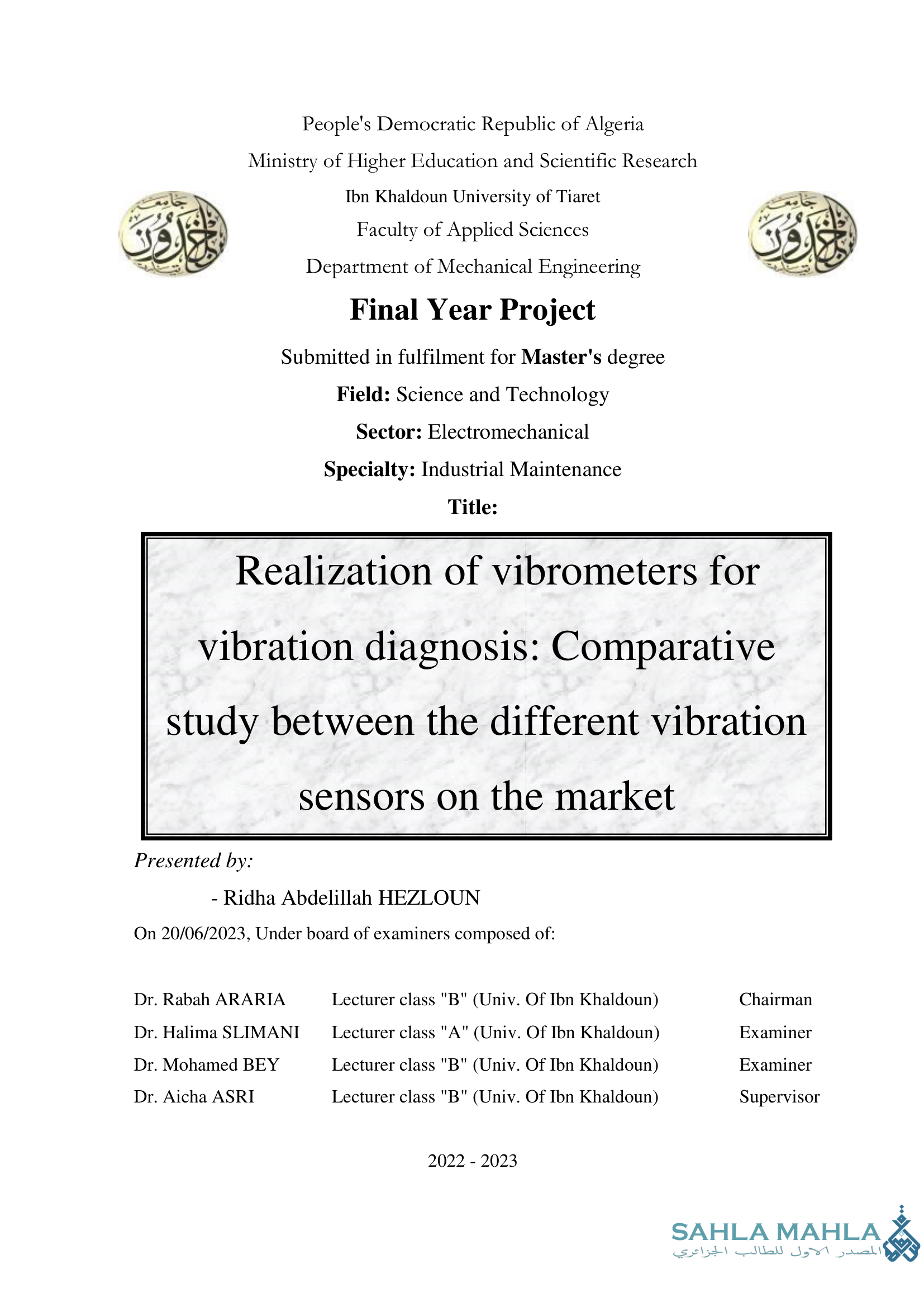
Cover Page:
Outline:
General introduction Chapter I: Vibration Analysis I.1. Introduction I.2. Vibration analysis meaning I.3. Vibration forms I.4. Physical nature of vibration I.4.1. Wave fundamentals I.4.2. Frequency (cycle) / period I.4.3. Wavelength I.4.4. Amplitude I.4.5. Phase I.4.6. Waveforms I.5. Vibration analysis process and application I.6. Vibration analysis principals I.6.1. Time domain I.6.2. Frequency domain I.6.3. Joint domain I.6.4. Modal analysis I.6.5. Time waveform I.6.5.1. Fast Fourier Transform (FFT) I.6.5.2. Phase measurement I.6.5.2. Order analysis I.6.5.3. Power spectral density (PSD) I.6.6. Envelope analysis I.6.7. Orbit I.6.8. Resonance analysis I.7. Vibration measurements I.7.1. Overall level of vibration I.7.2. Spectral analysis of vibration I.7.3. Discrete frequency monitoring I.7.4. Shock pulse monitoring I.7.5. Kurtosis measurement I.7.6. Signal averaging I.8. Vibration characteristics I.9. Vibration’s analysis measurements parameters I.9.1. Acceleration I.9.2. Displacement I.9.3. Velocity I.10. Vibration analysis tools and technologies I.11. Predictive maintenance based on vibration analysis I.11.1. Monitoring I.11.2. Diagnosis I.12. Benefits of continuous vibration monitoring I.12.1. Monitor critical equipment I.12.2. Monitor heavily used equipment I.12.3. Monitor difficult-to-access equipment I.13. Advantages and Limitations I.13.1. Advantages I.13.2. Limitations I.14. Conclusion Chapter II: Vibration Sensors Technologies II.1. Introduction II.2. Vibration sensors II.3. Types of vibrations detectors II.4. Principals and applications of vibrations detectors II.4.1. Operating principal II.4.1.1. Frequency II.4.2.2. Intensity II.4.2. Applications II.5. Machine types that use vibration sensing II.5.1. Water pumps II.5.2. Motors, gearboxes, and belts II.5.3. Fans and compressors II.5.4. Wind turbines II.5.5. Rolling bearings II.6. Vibration measurement diagram II.7. Set up of vibration analysis systems II.7.1. Sensor Mounting II.7.1.1. Wiring II.7.2. Monitoring System Set Up II.8. Some of accelerometer sensors II.8.1. MPU6050 Accelerometer II.8.1.1. MPU6050 Features II.8.1.2. Where to Use MPU6050 II.8.1.3. How to Use MPU6050 Sensor II.8.1.4. Applications II.8.2. ADXL335 Accelerometer II.8.2.1. Specification of ADXL335 II.8.2.2. How Accelerometer Works II.8.2.3. Features II.8.2.4. Applications II.8.2.5. Alternate options for ADXL335 II.8.3. LIS3DH Accelerometer II.8.3.1. How LIS3DH Accelerometer Works II.8.3.2. Features II.8.3.3. Applications II.8.4. MMA8452Q Accelerometer II.8.4.1. How MMA8452Q Accelerometer Works II.8.4.2. Features II.8.4.3. Applications II.9. The difference between the mentioned sensor II.10. Advantages & Disadvantages of Different Types of Vibration Sensors II.10.1. Accelerometers II.10.2. Velocity Sensors II.10.3. Displacement Sensors II.11. Conclusion Chapter III: Data collector test and analysis III.1. Introduction III.2. Operation project mechanism III.3. Materials part III.3.1. Arduino Uno III.3.2. Model installation plan III.3.3. System working principal III.4. Software Part III.4.1. Arduino IDE III.4.2. Python III.4.3. Fast Fourier Transform III.4.4. Serial Analyser III.4.5. Software programs working principal III.4.5.1. Arduino code III.4.5.2. Interfacing Arduino card with the analyser toolbox III.4.5.3. Fast Fourier Transformation III.5. Testing and experimentation of the project III.5.1. Time domain ADXL-335 vs MPU6050 III.5.1.1 Measurement on X Axis III.5.1.2 Measurement on Y Axis III.5.1.3 Measurement on Z Axis III.5.2. Frequency domain ADXL-335 vs MPU6050 III.5.2.1 Measurement on X Axis III.5.2.2 Measurement on Y Axis III.5.2.3 Measurement on Z Axe III.6. General discussion and results III.6.1. Discussion III.6.2. Results III.7. Conclusion General conclusion
Download The Thesis:
For more academic sources and references, including theses and dissertations from Algerian universities, , visit our main website.