


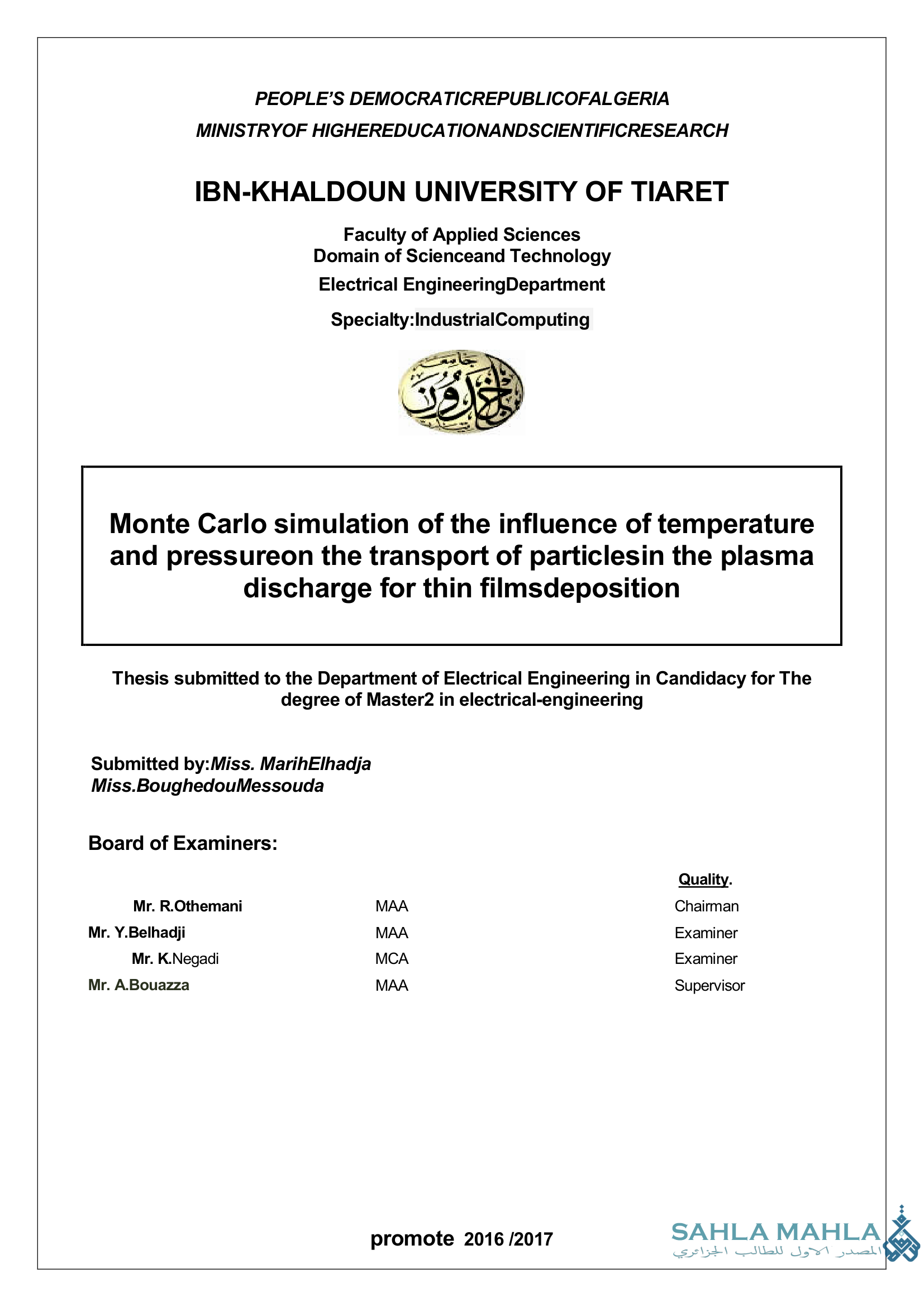
Monte Carlo simulation of the influence of temperature and pressureon the transport of particlesin the plasma discharge for thin filmsdeposition
General Information:
Master2 |
Level |
Monte Carlo simulation of the influence of temperature and pressureon the transport of particlesin the plasma discharge for thin filmsdeposition |
Title |
Industrial Computing |
Specialty |
Cover Page:
Outline:
INTRODUCTION 1.PLASMA 1.1. History. 1.2. Definition. SUMMARY Chapter I: Thin film preparation 1.3. Common forms of plasma 1.3.1. Terrestrial plasmas 1.3.2. Space and astrophysical plasmas. 1.4.Plasma parameters: Three fundamental parameters characterize a plasma: 1.4.1. the particle density n: 1.4.2. the temperature T: 1.4.3. the steady state magnetic field B: 1.5. Plasma classification 1.5.1. Pseudo-plasmas vs real plasma. 1.5.2. Cold warm and hot plasmas: 1.5.2.1. Hot plasma (thermal plasma). 1.5.2.2. Cold plasma (non-thermal plasma). 1.5.2.3. Ultra cold plasma. 1.5.3. Plasma ionization 1.5.4. Plasma densities. 1.5.5. Active and passive plasma 1.5.5.1. Passive plasma 1.5.5.2. Active plasma. 1.5.6. Ideal and non-ideal plasma. 1.6. Types of plasma. 1.7. HOW ARE PLASMAS MADE? 1.8. Plasma applications 2. Interaction. 2.1. History. 2.1.1. Classical theory. 2.2. Interaction between particles. 2.3. Collision between particles. 2.3.1. Elastic collision. 2.3.2. Inelastic collision 2.3.3. Comparison between Elastic and inelastic. 3. Thin films 3.1. Definition. 3.2. Thin films deposition. 3.2.1. Physical vapor deposition (PVD) 3.2.1.1. Physical evaporation. 3.2.1.2. Vacuum thermal evaporition. 3.2.1.3. SPUTTER DEPOSITION. 3.2.2. Chemical vapor deposition 3.2.2.1. Plasma-enhanced chemical vapor deposition (PECVD) 3.3. Importance of deposition technology in modern fabrication processes 3.4. Deposition Technologies and Applications Chapter II: Sputtering 1. Sputtering 1.1.Introduction 1.2.Generality 1.1 Sputtering Process 2. Sputtering yield formulas. 2.1 Sigmund formula. 2.2 Improvements made by other authors 2.3 Sputter yield formula obtained by Yamamura 3.Various Sputtering Regimes 3.1 Single Knock-On 3.2 Linear Collision Cascade. 4.General sputtering methodology 4.1 Reactive sputtering. 4.2RF (radio frequency) sputter deposition. 4.3. Magnetron sputtering. 4.4. Direct sputtering (DC sputtering). 4.5. Confocal sputtering 4.6. Pulsed DC Sputtering. 4.7. Ion Beam Sputtering. 5. Vacuum chamber 6. Sputter deposition advantages. 6.1 Advantages. 6.2. Disadvantages. 7. Sputtering system applications. Chapter III: Results and discussion 1. Monte Carlo method 1.1.Introduction. 1.2.History 1.3. Generality. 2. Monte Carlo Simulation. 3. SRIM 2013 (TRIM). 3.1. Generality. 4.Part one 4.1.Results found by SRIM simulation. 4.1.1. Variation of the ions sputtering yield for different metals 4.1.2. Variation of the ions sputtering yield for different gas. 5. Effects of Incidence Angle. 6. Part tow 6.1.SIMTRA (SImulation of Metal TRAnsport). 6.2 Influence of divers parameters on the number of sputtered atoms arriving at the substrate and their energy 6.2.1 Variation of chamber temperature. General conclusion
Download The Thesis:
For more academic sources and references, including theses and dissertations from Algerian universities, , visit our main website.