


Investigating the Teaching Strategies Effectiveness to Improve EFL Learner’s Listening and Speaking Skills Case of study: Primary Schools in Tiaret and Tissemsilt as Sample
General Information:
Master’s Degree |
Level |
Investigating the Teaching Strategies Effectiveness to Improve EFL Learner’s Listening and Speaking Skills Case of study: Primary Schools in Tiaret and Tissemsilt as Sample |
Title |
Didactics of Foreign Languages |
Specialty |
Cover Page:
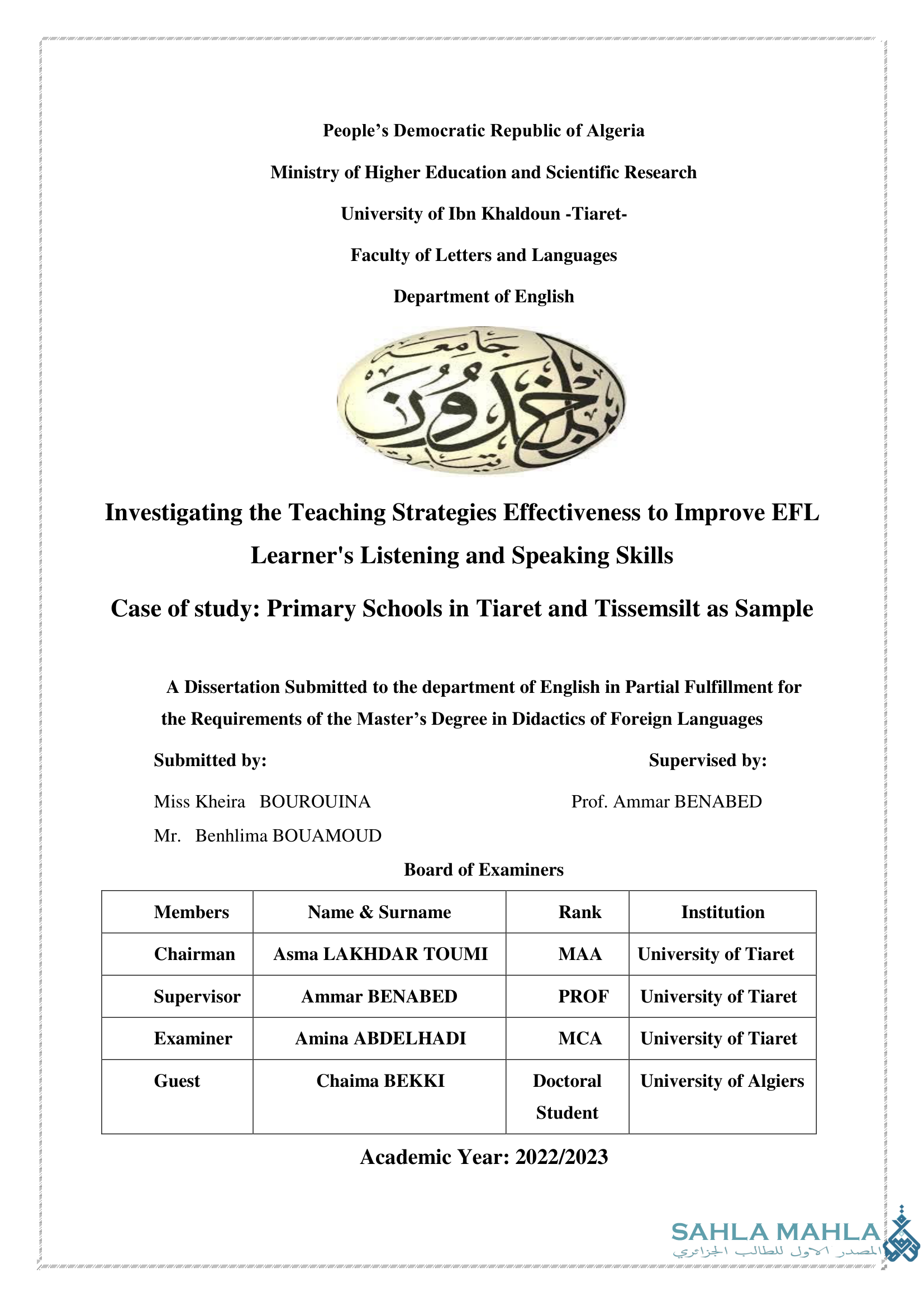
Outline:
General Introduction Chapter one: Literature Review Conceptualisation and Reframing Introduction I.1. English as a Global Language I.1.1. The Existence of English language in Algeria I.1.2. English in Algerian Primary Schools: 1993-2022 I.1.2.1.The Experience of 1993 I.1.2.2. The Official Integration of English in Primary School 2022 I.1.4. The Objectives behind Teaching English in Primary School 1.2. Teaching Strategies: Definition 1.2.1.Types of Teaching Strategies I.2.1.1.Traditional and Non-Traditional Teaching Strategies I.2.1.1.1 Traditional Strategies 1.2.1.1.1.Features of Traditional strategies 1.2.2.2. Non-Traditional Strategies I.2.2.2.1 Features of non-Traditional Strategies I.2.3.The Importance of Using Strategies in Teaching English 1.2.4 The Four Language Domains Strategies I.3.Teaching Listening and Speaking 1.3.1 Listening Skills: Definition 1.3.1.2.The Importance of Teaching Listening Skills 1.3.1.3 Stages of Teaching Listening Skills 1.4. Speaking Skills: Definitions 1.4.1. Types of Speaking Skills 1.4.2. Teaching Speaking Skills 1.4.2.1 Stages of Teaching Speaking in Classroom 1.4.3.2. The Importance of Teaching Speaking in Primary Schools 1.5. Strategies to Teach Listening and Speaking Skills 1.5.1. Reading Aloud A.5.2. Storytelling 1.5.3. Interviews 1.5.4. Conversations 1.5.5. Play Scripts 1.5.6. Role-play -Dialogue Acting 1.5.7. Repetition and its Value 1.5.8. Large and Small Groups Works I.6. The Integration of ICTs in Teaching English I.6.1. Benefits of Using ICTs in Teaching 1.6.1.1. Support Learner-centered and Self-direct Learning 1.6.1.2. Produce a Creative Learning Environment 1.6.1.3. Encourage Group Learning in a Distance Learning Setting 1.6.1.4. Give Learners more Chances to Practice Critical (higher-order) Thinking Skills 1.6.1.5. Support Teaching by Making Course Content more Accessible Conclusion Chapter Two: Research Design & Methodology Introduction 2.1. Case Study Approach 2.2. Sampling Technique: Rationale 2. 3. Research Methodology 2.4. Research Setting 2. 5. Case Study 2. 6. Target Samples 2. 7. Sampling Procedures 2. 8. Participants’ Profiles 2. 8. 1. 3rd Year Primary School Learners’ Profile 2. 8. 2. English Teachers’ Profile 2. 9. Data Collection Instruments 2. 9. 1. Questionnaire 2.9.2. Piloting Stage 2. 9. 3. Classroom Observation 2. 10. Describing Data Collection Instruments 2. 10. 1. Describing English Teachers’ Adressed Questionnaire 2. 10. 2. Classroom Observation Procedures 2. 11. Data Analysis Procedures Conclusion Chapter Three: Data Analysis & Interpretation Introduction 3.1.Teachers’ Questionnaire: Description and Aim 3.2.Classroom Observation 3.2.1. Classroom Observation One 3.2.2. Classroom Observation Two 3.2.3Classroom Observation Three 3.3.1 Discussion Conclusion Suggestions and Recommendations Limitations of the Study General Conclusion List of References
Download The Thesis:
For more academic sources and references, including theses and dissertations from Algerian universities, , visit our main website.