
Investigating the Effects of the 20th Century Modern Teaching Methods on Algerian Middle Schools pupils (A case study of ‘Baker Ben Hamad’ Middle School-Tiaret)
General Information:
Master |
Level |
Investigating the Effects of the 20th Century Modern Teaching Methods on Algerian Middle Schools pupils (A case study of ‘Baker Ben Hamad’ Middle School-Tiaret) |
Title |
Didactics |
Specialty |
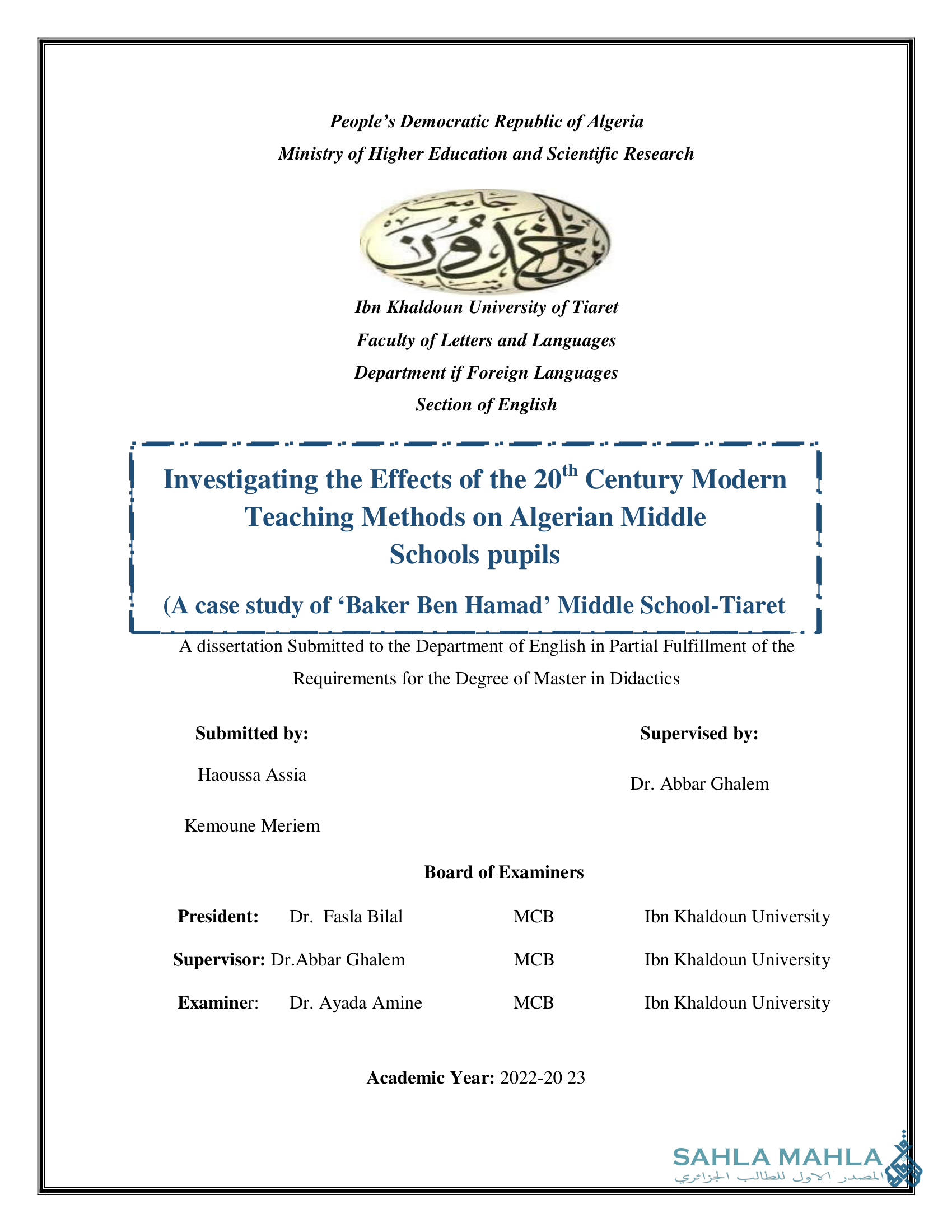
Cover Page:
Outline:
General Introduction Chapter one: Traditional teaching methods 1.2.1 The term Traditional teaching methods 1.2.2 Teaching 1.2.3 Traditional classroom teaching methods 1.2.4 Teacher-centered approach 1.3 Types of Traditional classroom teaching methods 1.3.1 The Grammar-Translation Method 1.3.1.1 Key features of the GTM 1.3.1.2 Students’ and Teachers’ Roles 1.3.2 The Direct Method 1.3.2.1 Principles of the DM 1.3.2.2 Teachers’ and Students’ Roles 1.3.3 The Audio-Lingual Method 1.3.3.1 The characteristics of the ALM 1.3.3.2 Teachers’ and Students’ Roles 1.3.4 The Natural Approach 1.3.4.1 Teachers’ and Students’ Roles 1.3.5 Silent Way 1.3.5.1 Teachers’ and students’ role 1.4 Characteristics of Traditional teaching methods 1.5 Traditional teaching methods as a bless or a curse 1.5.1 Traditional teaching methods as a bless 1.5.2 Traditional teaching methods as a curse 1.6 Methods that are still being used nowadays 1.6.1 Features of the methods that still in use 1.7 Conclusion Chapter two: Modern Teaching methods 2.2 New teaching methods 2.3 New generation 2.3.1 Generation Z characteristics 2.3.2 Generation Z learning preferences 2.3.3 Generation Z studying preferences 2.3.4 Generation Z learning styles according to the Barnes & Noble College (2016) 2.4 The good teacher for Generation Z 2.5 Learner-centered approach 2.6 The modern Teaching methods 2.6.1 Collaborative learning 2.6.1.1 Strategies of Collaborative learning 2.6.1.2 The silent features of Collaborative learning 2.6.2 Spaced Learning 2.6.2.1 Spaced Learning Design 2.6.3 Flipped Classroom 2.6.3.1 Pillars of Flipped Learning 2.6.4 Game-Based Learning 2.6.4.1 Computer games vs Educational games 2.6.4.2 The Benefits of GBLs 2.6.5 VAK Learning 2.6.6 Crossover Learning 2.6.7 Competency-Based Teaching 2.6.7.1 Competency based approach 2.6.7.2 Competency-based education 2.6.7.3 Competency based learning 2.6.8 Flashcards Learning 2.6.8.1 Why flashcards are useful? 2.7 Characteristics of Modern Teaching Methods 2.8 Advantages of Modern Teaching 2.9 Conclusion Chapter three: Research Methodology and results 3.1 Introduction 3.2 Research Design 3.2.1 The purpose of the study 3.2.2 Method 3.2.3 Setting and Participants 3.2.4 Data collection instruments 3.2.4.1 Description of the Teacher questionnaire 3.2.4.2 Description of the Classroom Observation 3.3 Findings and Discussion of Results 3.3.1 Teachers’ Questionnaire results 3.3.1.1 Interpretation of results 3.3.2 Classroom observation 3.3.2.1 Interpretation of results 3.4 Recommendations 3.4.1 Recommendations for Teachers 3.5 Conclusion General conclusion
Download The Thesis:
For more academic sources and references, including theses and dissertations from Algerian universities, , visit our main website.