


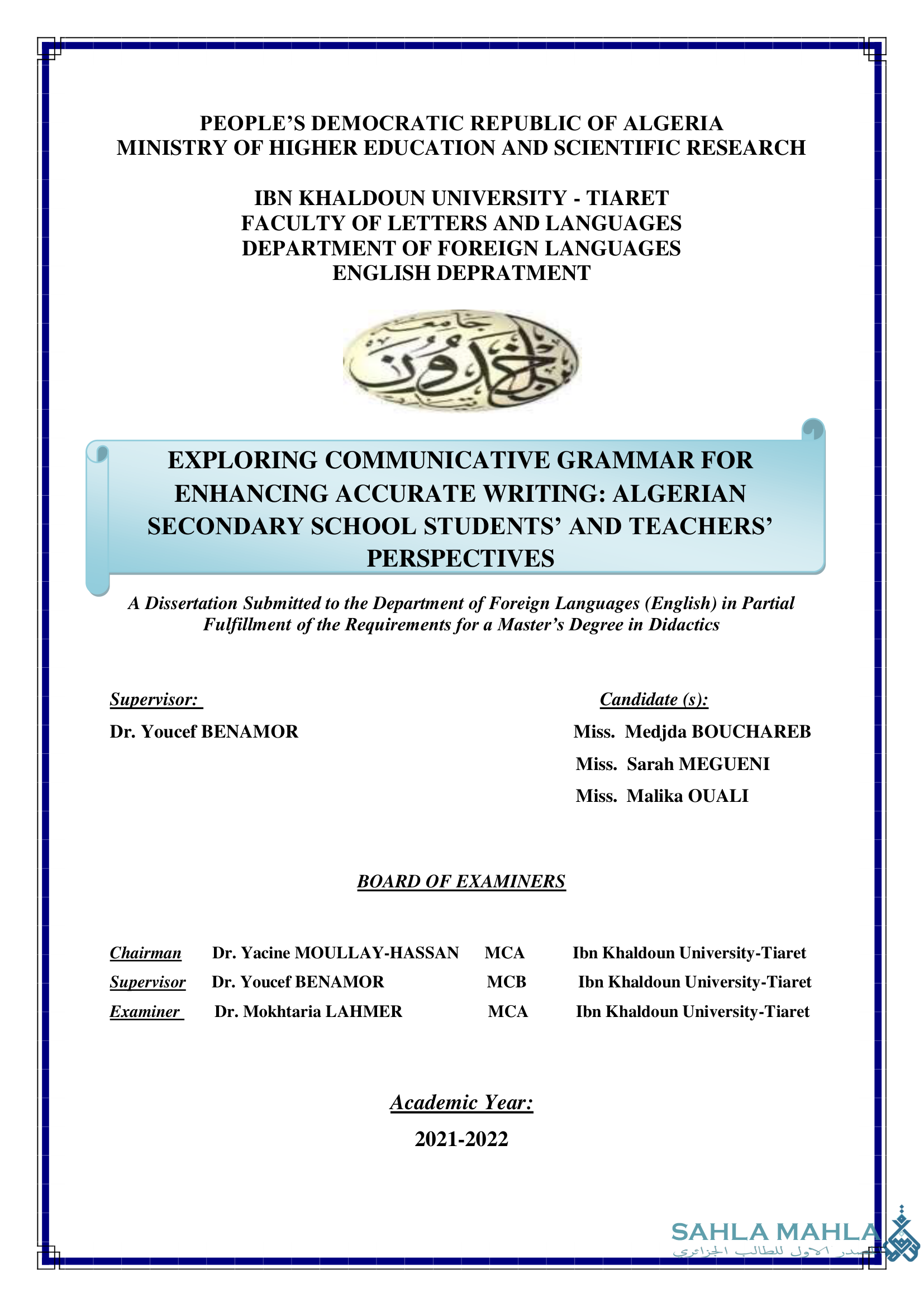
EXPLORING COMMUNICATIVE GRAMMAR FOR ENHANCING ACCURATE WRITING: ALGERIAN SECONDARY SCHOOL STUDENTS’ AND TEACHERS’ PERSPECTIVES
General Information:
Master’s Degree |
Level |
EXPLORING COMMUNICATIVE GRAMMAR FOR ENHANCING ACCURATE WRITING: ALGERIAN SECONDARY SCHOOL STUDENTS’ AND TEACHERS’ PERSPECTIVES |
Title |
Didactics |
Specialty |
Cover Page:
Outline:
GENERAL INTRODUCTION Background to the Study (Contextualization) Research Questions Hypotheses Aims and Objectives of the Study Significance of the Study Research Methodology A. Sample Population B. Data Collection Methods and Procedures Organization of the work Delimitation of the Study CHAPTER ONE: TEACHING GRAMMAR Introduction 1.1 Definition of Grammar 1.2 The Importance of Grammar in Language Teaching 1.3 Changes in Grammar Teaching 1.4 Types of Grammar 1.4.1 Prescriptive Grammar 1.4.2 Descriptive Grammar 1.4.3 Contextualized Grammar 1.4.3.1 Principles for Creating Context for Grammar teaching 1.4.3.2 Models of Teaching Grammar Communicatively 1.5 Instructional Grammar Based-Approaches 1.6 Models of Grammar Instruction: PPP Model 1.7 Challenges of Teaching Grammar Communicatively Conclusion CHAPTER TWO: COMMUNICATIVE GRAMMAR AND WRITING Introduction 2.1. Grammatical Knowledge 2.2 Grammar as a Form and Function 2.2.1 Grammar as Form 2.2.2 Grammar as Function 2.3 Approaches to teaching Grammar Communicatively 2.3.1 The Deductive Approach DA vs. the Inductive Approach IA 2.3.2 The Communicative Language Teaching CLT 2.3.3 Communicative Grammar (CG) and CLT 2.3.4 The Advantages of Teaching Grammar Communicatively 2.4 Approaches to Writing 2.4.1 The Product Approach 2.4.2 The Process Approach 2.4.3 Genre Approach 2.4.4 Creative Writing (CW) 2.5 Definition of Accuracy 2.5.1 Grammatical Accuracy 2.5.2 The Contribution of Grammatical Accuracy to L2 Writing 2.6 Communicative Grammar and Accurate Writing Conclusion CHAPTER THREE: RESEARCH METHODOLOGY AND DATA ANALYSIS Introduction 3.1 Research Design and Methods 3.1.1 Description and Objectives of the Online Questionnaires 3.1.2 Sampling Method and Target Population A. Teachers’ Profile B. Students Profile 3.2 Data Analysis 3.2.1 Teachers’ Online Questionnaire Results 3.2.3 Students’ Online Questionnaire Results 3.3 Discussion of the Questionnaires Results 3.4 Recommendations and Implications 3.5 Limitations of the Study 3.6 Suggestions for Further Research General Conclusion
Download The Thesis:
For more academic sources and references, including theses and dissertations from Algerian universities, , visit our main website.