


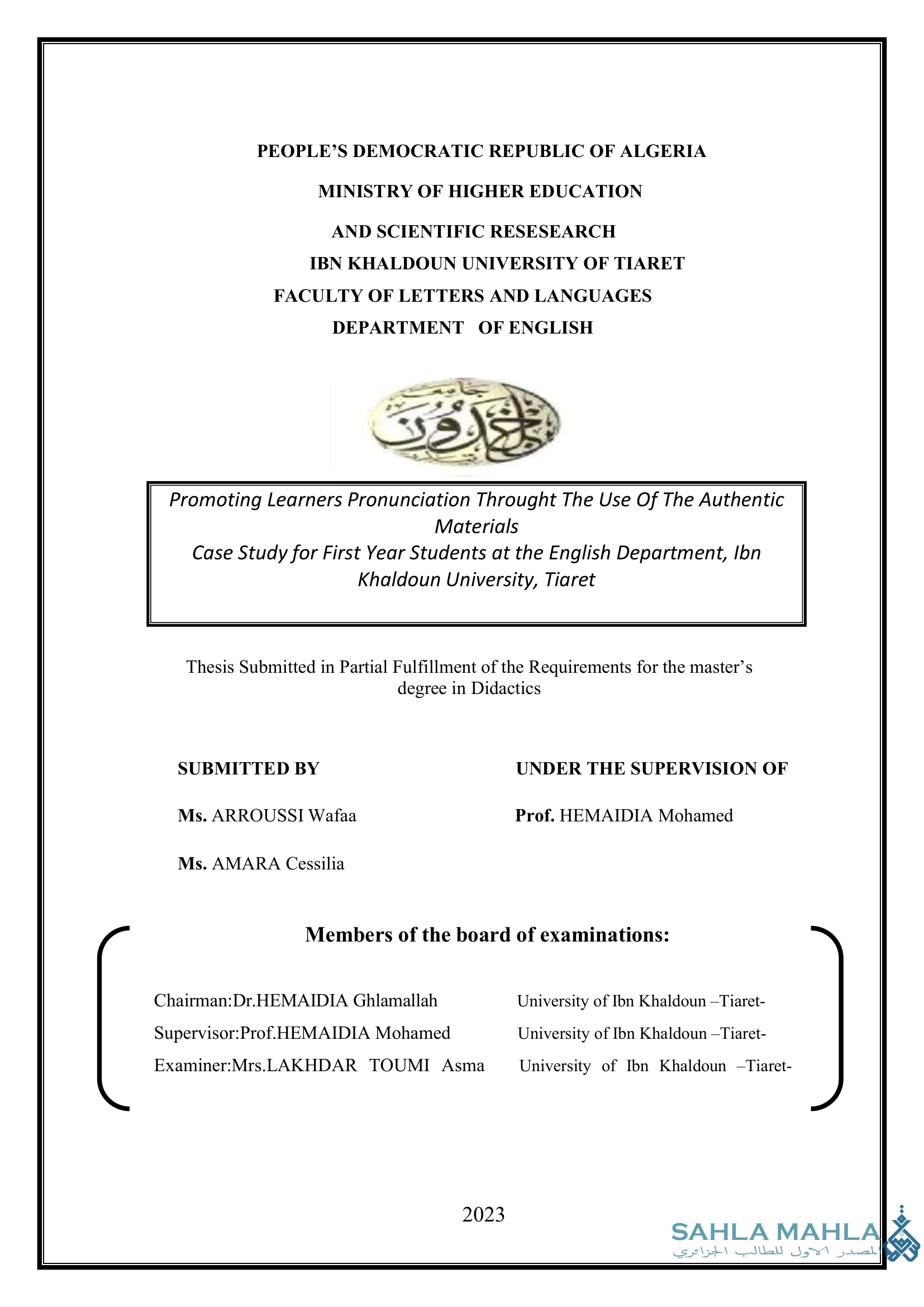
Promoting Learners Pronunciation Throught The Use Of The Authentic Materials
General Information:
master’s degree |
Level |
Promoting Learners Pronunciation Throught The Use Of The Authentic Materials |
Title |
Didactics |
Specialty |
Cover Page:
Outline:
General Introduction Chapter one: theoretical Review: Pronunciation for EFL Learners Introduction 1 English pronunciation 2-phonitics in English Pronunciation 2.1. Phonetics 2.1.1-.Definition of phonetics 2.1.2-.Parts of Phonetics 2.1.3-Aspects of phonetics 2.2.Word stress 2.2.1-Syllable 2-2.2- Word Stress 2.2.3-.Connection between Syllable and Word stress 2.3-Sentence Stress: 2.3.1 -Sentence stress 2.3.2-Types of Sentence stress 3-Elements of English pronunciation 3.1-Stress 3.2-Pitch 3.3-Rythm 3.4-Intonation 4-Principles of English Pronunciation 5-The importance of English Pronunciation 6- The difference between Spelling and Pronunciation 7- The difference between British and American pronunciation 8-English Pronunciation problems and difficulties 9- Pronunciation Errors commited by EFL.learners (Errors, mistakes) 10- Difference between spelling errors and spelling mistakes Conclusion Chapter two: Overview about the use of authentic material for EFLclass Introduction 1. Authentic materials 2. Sources of authentic materials in EFL courses 2.1 Literature 2.2 The broadcast media 2.3 Television 2.3 Newspapers 2.4 Songs 2.5ICT 2.5.1 Internet 2.5.2 EFL courses 2.5.3 Websites 3. Type of authentic materials: 3.1 Authentic Audio Visual Materials 3.2 Authentic Visual Materials 3.3 Authentic Printed Materials 3.4 Realia 4-Courses taught through authentic materials: 4.1- Reading and writing 4.2-Listnening and speaking 4.3-Business 4.4-Culture and society 5-Learners’ attitudes toward authentic materials 6-Advanteges of using authentic materials 7-Disadvateges of using authentic materials 8- Factors to consider when selecting authentic materials: 8.1- Criteria for selecting authentic materials: 8.1.1 Authenticity 8.1.2Accessibility 8.1.3 Appropriatness 8.1.4Applicability 8.1.5 Adaptability 8.2-Learners’ autonomy 8.2.1- Language proficiency level 8.2.2-Relevance and interest 9-Authentic materials and student’s motivation 10-Improvement of students’ English performance through the use of authentic materials -Conclusion Chapter three: field work Introduction: 1. Population 1.1. Students 1.2. Teachers 2. Data collection tools 2.1. Student’s questionnaire 2.2 Recording of Students’ speech 2.3 Teacher’s interview 3. Data analysis 3.1. Analysis of results obtained from learners questionnaire 3.2. Analyses of results obtained from the recording of students’ speech 3.3. Analysis of results obtained from teachers’ interview 4. Data discussion and interpretation 5. Recommendation and suggestion Conclusion General conclusion
Download The Thesis:
For more academic sources and references, including theses and dissertations from Algerian universities, , visit our main website.