


Investigating the Phonological Processes for Children’s English Language in Algerian Kindergartens with reference to Kids Space
General Information:
Master’s Degree |
Level |
Investigating the Phonological Processes for Children’s English Language in Algerian Kindergartens with reference to Kids Space |
Title |
English Linguistics |
Specialty |
Cover Page:
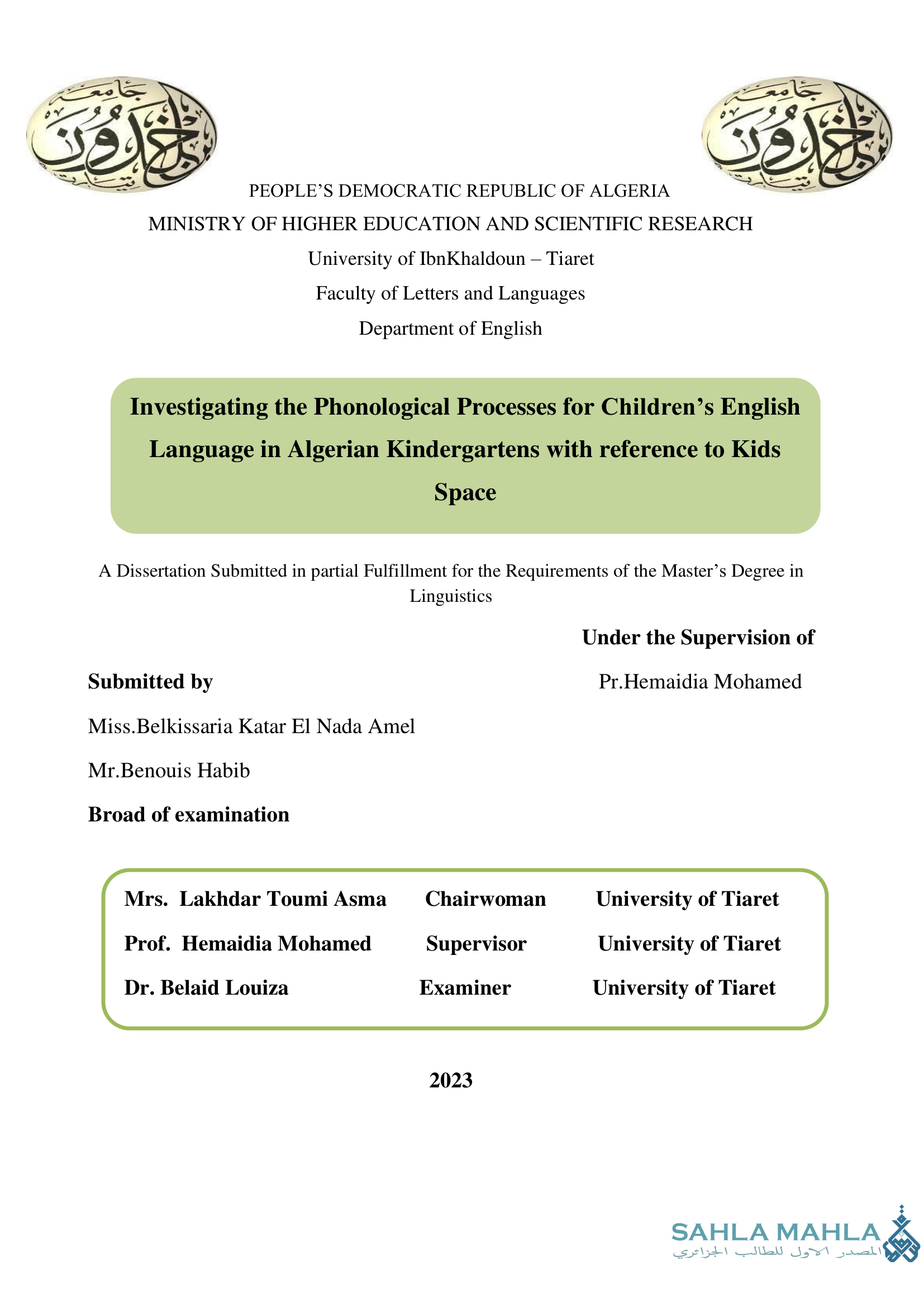
Outline:
General Introduction I. Introduction/ Topic II. Research Motivation III. Research questions IV. Research Hypotheses IV. Research Methodology V. Process 1.Literature Review 1.1 Background and Rationale: Chapter One: Literature Review 1.2 Cross-Linguistic Influence on Phonological Processes: 1.3 English Language Teaching in Algerian Kindergartens: 1.4 Previous Studies on Algerian Children’s Phonological Processes: 1.5 Methodologies for Investigating Phonological Processes: 1.5.1 Articulation Assessment: 1.5.2 Phonological Processes Assessment: 1.5.3 Speech sound discrimination: 1.5.3.1 Goldman-Fristoe Test of Articulation (GFTA): 1.5.3.2 The Comprehensive Test of Phonological Processing (CTOPP): 1.5.3.3 Khan-Lewis Phonological Analysis (KLPA): 1.6 Analysis of speech samples and transcription: 1.6.1 Collect speech samples: 1.6.2 Create transcriptions: 1.6.3 Identify patterns: 1.6.4 Categorize phonological processes: 1.6.5 Analyze the contexts: 1.6.6 Compare with linguistic rules: 1.6.7 Hypothesize explanations: 1.6.8 Test hypotheses: 1.6.9 Document findings: 1.6.10 Interpretation and implications: 1.7 Exploring Speech Perception: 1.7.1 Phoneme Discrimination: 1.7.2 Phoneme Categorization: 1.7.3 Word Recognition: 1.7.4 Lexical Access: 1.7.5 Speech Segmentation: 1.7.6 Speech-in-Noise: 1.7.7 Sentence Processing: 1.8. Factors Influencing Phonological Processes in Kindergarten in Algeria 1.8.1.Socioeconomic status: 1.8.2.Bilingualism: 1.8.3. Language exposure and input: 1.8.4. Cultural and dialectal variations: 1.9. The role of cognitive and linguistic factors in phonological development in Algeria: 1.9.1. Cognitive Factors: 1.9.1.1 Auditory Processing Skills: 1.9.1.2Working Memory: 1.9.1.3. Attention and Focus: 1.9.2. Linguistic Factors: 1.9.2.1.Language Input: 1.9.2.2. Phonological Awareness: 1.9.2.3. Vocabulary and Language Skills: 1.10. Cultural and Environmental Factors: 1.10.1. Language Exposure: 1.10.2. Socioeconomic Status: 1.11. Assessment and intervention for phonological disorders: 1.11.1. Importance of Early Identification: 1.11.2. Screening and Assessment: 1.11.3. Individualized Intervention: 1.11.3.1. Speech Sound Production: 1.11.3.2. Phonological Awareness: 1.11.3.3. Environmental Enrichment: 1.11.3.4. Parent and Teacher Involvement: 1.11.4. Multicultural Considerations: 1.11.5. Ongoing Monitoring and Support: Chapter TwoMethodology 2.1Overview: 2.2 Research Questions: 2.3 Research Hypothesis: 2.4 Research Design: 2.5 The participants: 2.5 Research Setting: 2.6 Methods of data: 2.6.1 The Questionnaire: 2.6.2 Observation: 2.6.3 Interview: Chapter Three Findings and discussion 3.1 Data Analysis 3.1.1 Questionnaire Analysis 3.2Data Discussion and Interpretation: 3.2.1 Observation analysis: 3.2.2Interview analysis: Conclusion: Bibliography:
Download The Thesis:
For more academic sources and references, including theses and dissertations from Algerian universities, , visit our main website.