


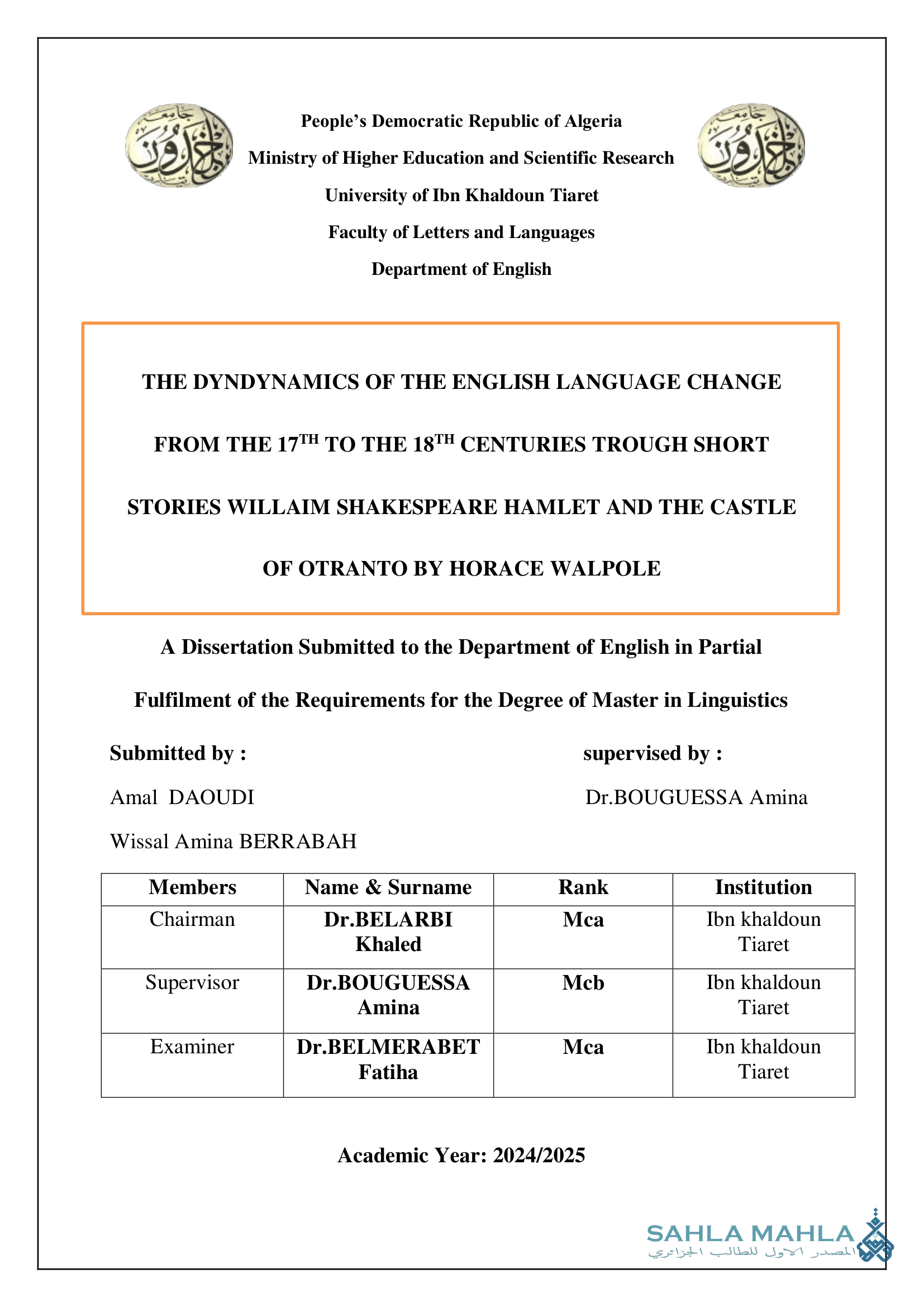
THE DYNDYNAMICS OF THE ENGLISH LANGUAGE CHANGE FROM THE 17TH TO THE 18TH CENTURIES TROUGH SHORT STORIES WILLAIM SHAKESPEARE HAMLET AND THE CASTLE OF OTRANTO BY HORACE WALPOLE
General Information:
Master |
Level |
THE DYNDYNAMICS OF THE ENGLISH LANGUAGE CHANGE FROM THE 17TH TO THE 18TH CENTURIES TROUGH SHORT STORIES WILLAIM SHAKESPEARE HAMLET AND THE CASTLE OF OTRANTO BY HORACE WALPOLE |
Title |
Linguistics |
Specialty |
Cover Page:
Outline:
GENERAL INTRODUCTION CHAPTER ONE: EARLY MODERN ENGLISH SHIFT (17TH CENTURY) – HAMLET AND THE FOUNDATIONS OF CHANGE Introduction OVERVIEW OF THE 17TH CENTURY Early modern English Modern English MAJOR EVENTS THAT CONTRIBUTED IN ENGLISH LAMGUAGE The Renaissance (1300-1500) Key Factors contributing to the language transformation Printing press and the invention of movable type printing Movable type printing Education Communication technologies New knowledge Linguistic self- Consciousness The reformation Bible translation THE ENRICHMENT OF ENGLISH VOCABULARY AND GRAMMAR Vocabulary Transformation Grammar and Morphology Nouns Numbers Pronouns Verbs PHONOLOGICAL CHANGES The Great Vowel Shift Raising of diphthongization Back vowel shift Vowel shorting and changes in middle and early modern English The effect of Great Vowel Shift The orientation of the /3/ Sound The loss of X sound Traditional dialects and vowel change: Northern English, Scottish English, and RP (RESEIVED PEONUNCIATION) STANDARDIZATION OF SPELLING Spelling Grammar Nouns and adjectives Personal pronouns Reflexive pronouns Relative pronouns Modal and auxiliary adverbs and conjunction SHAKESPEARE STYLE DURING EARLY MODERN ENGLISH Conclusion CHAPTER TWO: MODERN ENGLISH SHIFT (18TH CENTURY)-THE CASTLE OF OTRANTO Introduction MAIN CHARACTERISTICS OF THE 18TH CENTURY Standardization of English language The Beginnings of Prescriptive Grammar GRAMMARIANS INFLUENCE AND INTENTIONS IN SHAPING MODERN ENGLISH LANGUAGE Vocabulary reform and linguistic change in the modern English period The lasting consequences of grammatical reform in the modern English era LINGUISTIC REFINEMENT AND CODIFICATION DURING THE 18TH CENTURY Key Contributors to 18th-Century English Language Change STANDARDIZATION MOVEMENT AND ITS PEAK Major Changes during standardization The first stage (1701-1760) The second stage 1761-1830 The third stage 1831-1870 MODERN SPELLING SHIFT THE RISE OF NEW FACTORS BEHIND ENGLISH LANGUAGE CHANGE The influence of Neoclassicism The Latin Influence The Greek Influence LATER 18TH CENTURY PROSE AND THE GOTHIC NOVEL The Rise of the Novel Definition of Novel Origins of Novel Ready Materials Factors that Contributed in The Rise of The Novel Drama Classicism The 18th Century Novel sample THE INDUSTRIAL REVOLUTION The Impact of the Industrial Revolution on English Vocabulary The Emergence of Technological Vocabulary Scientific Terminology Literary and Cultural transformation THE ROLE OF BRITISH IN THE GLOBAL SPREAD OF THE ENGLISH LANGUAGE THE DOWN OF THE INDUSTRIAL REVOLOUTION SOCIAL CLASSES AND LANGUAGE CHANGE DURING THE 18TH CENTURY THE INFLUENCE OF THE RHEOTORIC TYPE ON LANGUAGE IN THE 18TH CENTURY THE GROWTH OF DICTIONARIES AT THE 18TH CENTURY THE GREAT CONTRIBUTION OF JOHNSON*S DICTIONARY TO THE ENGLISH LANGUAGE LEXICAL EXPANSION IN THE ENGLISH LINGUISTIC CHANGE AND WORD FORMATION IN THE 18TH CENTURY Imitation or Onomatopoeia The Older word and the new significance (extended meaning) The use of the same word in different part of speech Addition of Suffixes or Prefixes Syncopation Telescoping Met analysis Portmanteau Words Back-Formation Corruption or Misunderstanding False Etymology Slang term entering literary Vocabulary Words derived from Proper Nouns Conscious and Deliberate Coinages Words taken from foreign languages Conclusion CHAPTER THREE: METHODOLOGY AND THE PRACTICAL PART Introduction SECTION ONE: William Shakespeare The Tragedy of Hamlet, prince of Denmark Characterization Themes Language Qualitative comparative: Hamlet story (English during the 17th century) Qualitative comparative analysis SECTION TWO: Horace Walpole The Emergence of Gothic Narrative Literary Impact and Criticism The Castle of Otranto (Horace Walpole’s Gothic Vision) Language and Structure Qualitative comparative: the castle of Otranto story (English during the 18th century) Qualitative comparative analysis Conclusion GENERAL CONCLUSION List of references
Download The Thesis:
For more academic sources and references, including theses and dissertations from Algerian universities, visit our main website.