


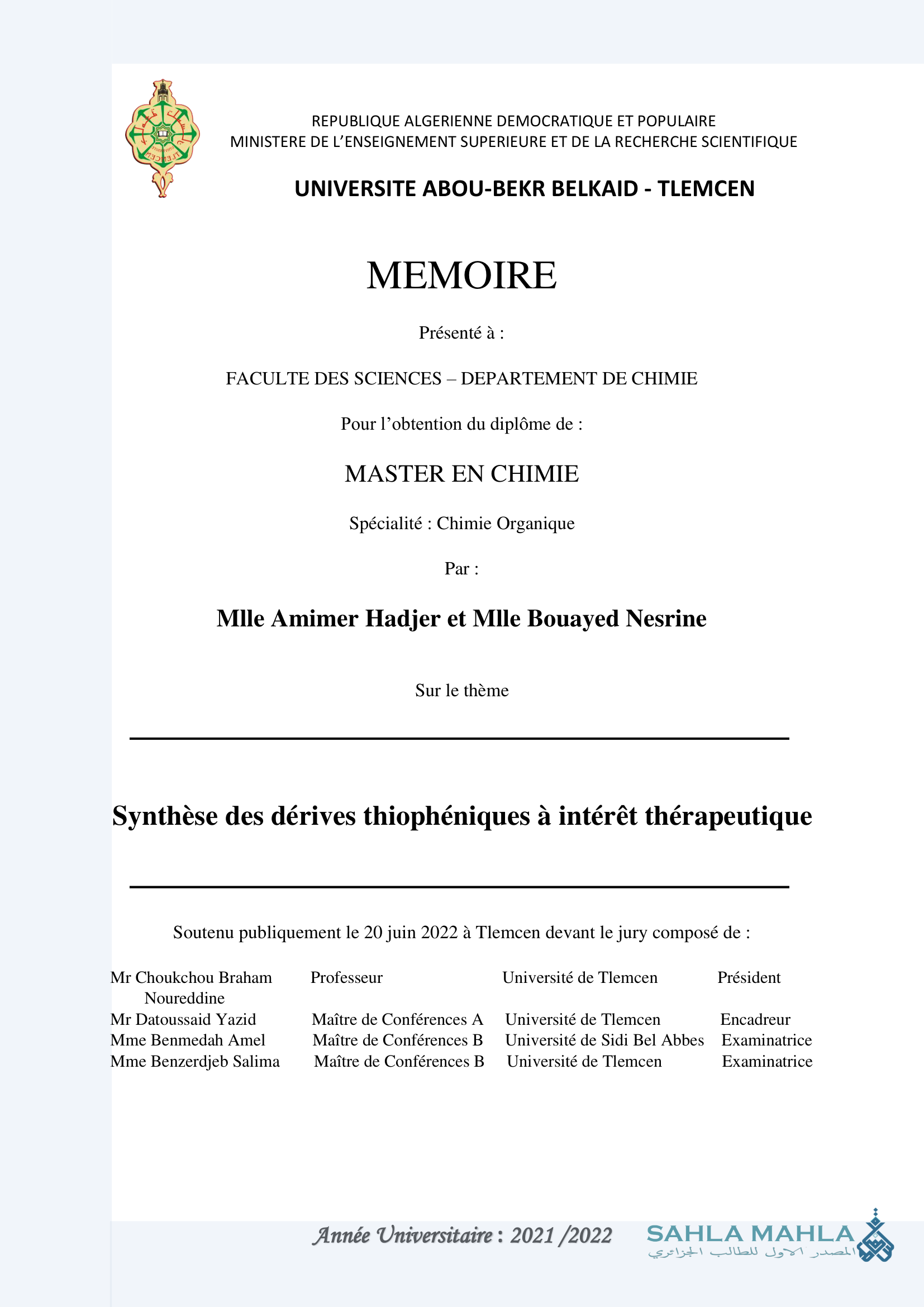
Synthèse des dérives thiophéniques à intérêt thérapeutique
Des informations générales:
Le niveau |
Master |
Titre |
Synthèse des dérives thiophéniques à intérêt thérapeutique |
SPECIALITE |
Chimie Organique |
Page de garde:
Sommaire:
Introduction générale
Présentation du sujet
Chapitre I : Étude bibliographique
I. Réaction de Vilsmeier-Haack
I.1. Introduction
1.2. Propriétés physiques des réactifs de Vilsmeir-Haack
I.3.Applications du réactif de Vilsmeir-Haack en synthèse organique
A. Réaction de formylation
Formylation des hétérocycles
Formylation des amines
B. Chloration
C. Chloroformylation
D. Aromatisation
E. Cyclisation
F. Autres applications de Vilsmeier-Haack
II. Thiophene
II.1. Introduction
II.2. Synthèse
III. Pyrazole
III.1. Introduction
III.2. Synthèses
Chapitre II: Résultats et Discussion
I. Introduction
II. Préparation du produit de départ
II.1. Formation du réactif de Vilsmeier-Haack
II.2. Préparation des dérivés des ß-chloroacroléïnes
Mécanisme de formation de sel et des dérivés des ẞ-chloroacroléïnes 19
Résultat
III. Cyclisation en 5-aryl-2-acétylthiophènes
Mécanisme
Résultat
IV. Cyclisation en pyrazole
Mécanisme
Résultat
Chapitre III : Partie Expérimentale
Matériels et méthodes
I. Synthèse des ẞ-chloroacroleïnes
3-chloro-3-(4-méthoxyphenyl) acrylaldéhyde
3-chloro-3-(3-nitrophenyl) acrylaldéhyde
3-chloro-3-(4-fluorophenyl) acrylaldéhyde
3-chloro-3-(2,4-dichlorophenyl) acrylaldéhyde
3-chloro-3-(4-méthylphenyl) acrylaldéhyde
II. Synthèse des cycles thiophéniques
1-(5-(4-methoxyphenyl) thiophén-2-yl) éthanone
1-(5-(3-nitrophenyl) thiophén-2-yl) éthanone
1-(5-(4-fluorophenyl) thiophén-2-yl) éthanone
1-(5-(2,4-dichlorophenyl) thiophén-2-yl) éthanone
1-(5-(p-tolyl) thiophén-2-yl) éthanone
III. Synthèse des pyrazoles
5-(3-nitrophenyl) -1H-pyrazole
Conclusion générale
Références
Présentation du sujet
Chapitre I : Étude bibliographique
I. Réaction de Vilsmeier-Haack
I.1. Introduction
1.2. Propriétés physiques des réactifs de Vilsmeir-Haack
I.3.Applications du réactif de Vilsmeir-Haack en synthèse organique
A. Réaction de formylation
Formylation des hétérocycles
Formylation des amines
B. Chloration
C. Chloroformylation
D. Aromatisation
E. Cyclisation
F. Autres applications de Vilsmeier-Haack
II. Thiophene
II.1. Introduction
II.2. Synthèse
III. Pyrazole
III.1. Introduction
III.2. Synthèses
Chapitre II: Résultats et Discussion
I. Introduction
II. Préparation du produit de départ
II.1. Formation du réactif de Vilsmeier-Haack
II.2. Préparation des dérivés des ß-chloroacroléïnes
Mécanisme de formation de sel et des dérivés des ẞ-chloroacroléïnes 19
Résultat
III. Cyclisation en 5-aryl-2-acétylthiophènes
Mécanisme
Résultat
IV. Cyclisation en pyrazole
Mécanisme
Résultat
Chapitre III : Partie Expérimentale
Matériels et méthodes
I. Synthèse des ẞ-chloroacroleïnes
3-chloro-3-(4-méthoxyphenyl) acrylaldéhyde
3-chloro-3-(3-nitrophenyl) acrylaldéhyde
3-chloro-3-(4-fluorophenyl) acrylaldéhyde
3-chloro-3-(2,4-dichlorophenyl) acrylaldéhyde
3-chloro-3-(4-méthylphenyl) acrylaldéhyde
II. Synthèse des cycles thiophéniques
1-(5-(4-methoxyphenyl) thiophén-2-yl) éthanone
1-(5-(3-nitrophenyl) thiophén-2-yl) éthanone
1-(5-(4-fluorophenyl) thiophén-2-yl) éthanone
1-(5-(2,4-dichlorophenyl) thiophén-2-yl) éthanone
1-(5-(p-tolyl) thiophén-2-yl) éthanone
III. Synthèse des pyrazoles
5-(3-nitrophenyl) -1H-pyrazole
Conclusion générale
Références
Télécharger:
Pour plus de
sources et références universitaires
(mémoires, thèses et articles
), consultez notre site principal.