


Formulation d’un sirop antitussif à base de produits synthétiques et végétaux
Des informations générales:
Le niveau |
Doctorat |
Titre |
Formulation d’un sirop antitussif à base de produits synthétiques et végétaux |
SPECIALITE |
Pharmacie |
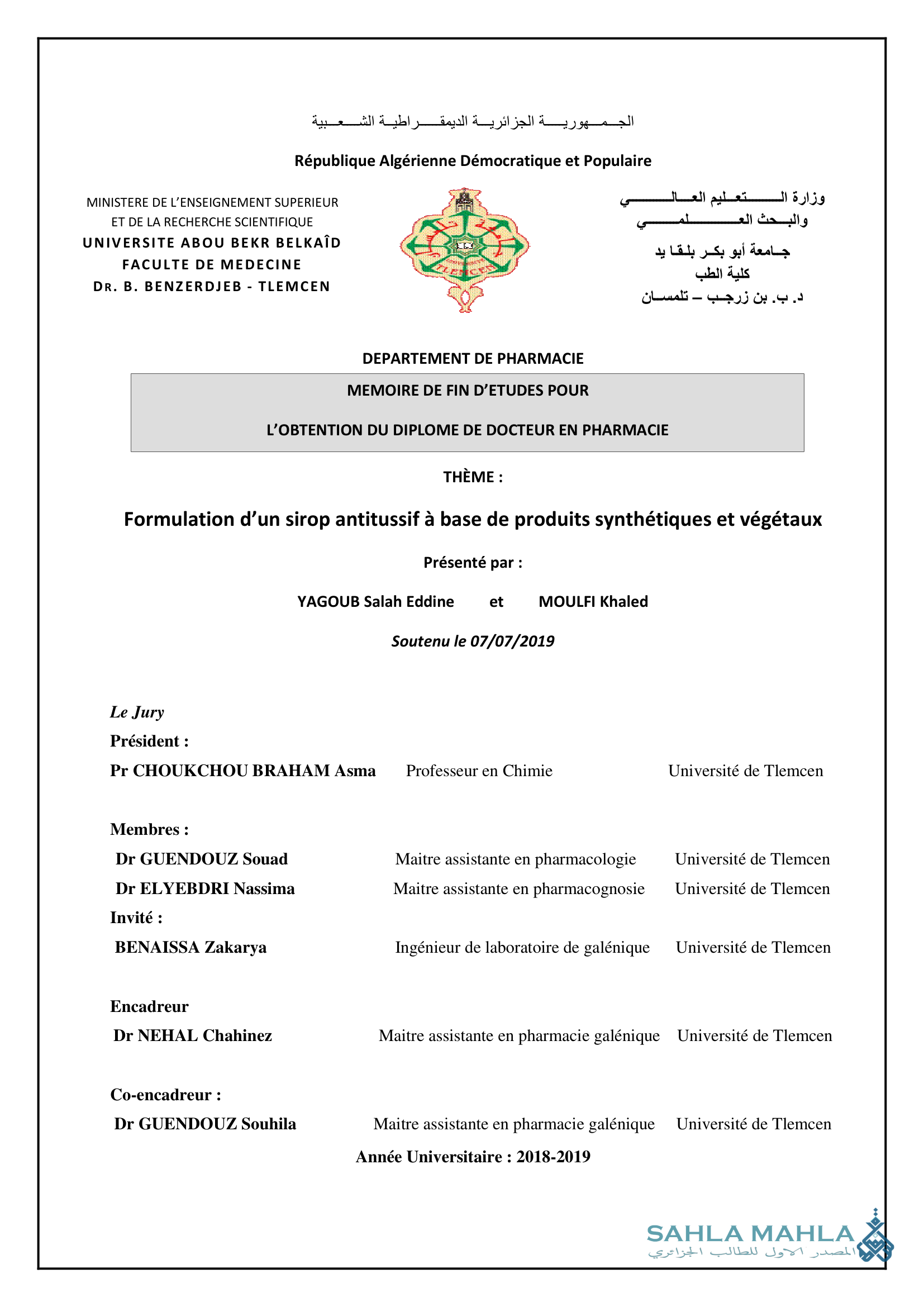
Page de garde:
Sommaire:
INTRODUCTION GENERALE
PARTIE 01: DONNEE BIBLIOGRAPHIQUE
CHAPITRE I: ETUDE DE LA TOUX.
I. DEFINITION
II. DUREE DE LA TOUX
III. PRINCIPAUX TYPES DE LA TOUX
IV. SYMPTOMES DE LA TOUX
V. ÉPIDEMIOLOGIE
VI. PATHOPHYSIOLOGIE
VII. ETIOLOGIES
VIII. FACTEURS DE RISQUE
IX. TRAITEMENT MEDICAMENTEUX DE LA TOUX :
IX.1. Définition d’un médicament.
Médicaments de la toux
IX.2.
IX.3. Composition d’un médicament
IX.4. Origine des constituants d’un médicament
CHAPITRE II : ESSAIS PRECLINIQUES D’UN EXPECTORANT
I. IDENTIFICATION DES SUBSTANCES ACTIVES
II. ETUDE PHARMACOLOGIQUE DES PRINCIPES ACTIFS :
II.1. Thymol.
II.1.1. Propriétés pharmacocinétiques.
II.1.2. Propriétés pharmacologiques
II.1.3. Effets secondaires.
II.1.4. Contres indications.
II.1.5. Interactions médicamenteuses.
II.2. Eucalyptol
II.2.1. Propriétés pharmacocinétiques.
II.2.2. Propriétés pharmacologiques
II.2.3. Effets secondaires.
II.2.4. Contre-indications
II.2.5. Interactions médicamenteuses
II.3. Menthol
II.3.1. Propriétés pharmacocinétiques
II.3.2. Propriétés pharmacologiques
II.3.3. Effets secondaires.
II.3.4. Contre-indications
II.3.5. Interactions médicamenteuses
II.4. Extrait de réglisse
II.4.1. Propriétés pharmacologiques.
II.4.2. Effets secondaires
II.4.3. Interactions médicamenteuses
III. ETUDE TOXICOLOGIQUE DES PRINCIPES ACTIFS
III.1. Thymol
III.2. Eucalyptol
III.3. Menthol
CHAPITRE III: DEVELOPPEMENT GALENIQUE D’UN SIROP A PROPRIETES EXPECTORANTES
I. PRE FORMULATION : ETUDE DES PROPRIETES PHYSICOCHIMIQUES
1.1. Thymol.
1.2. Eucalyptol
1.3. Menthol
II. FORMULATION D’UN SIROP :
II.1. La voie d’administration
II.2. La forme galénique
II.3. Les excipients
II.4. Le procédé de fabrication
II.5. Le conditionnement et les conditions de conservation
II.6. Contrôle de qualité d’un sirop
PARTIE 02: PARTIE PRATIQUE.
I. DESCRIPTION DE L’ETUDE
II. MATERIEL ET METHODE.
II.1. Matériel:
II.2. Méthode :
II.2.1. Identification des substances actives
II.2.2. Choix de la voie d’administration
II.2.3. Choix de la forme galénique
II.2.4. Choix des excipients
II.2.5. Choix du procédé de fabrication
II.2.6. Contrôle du produit fini.
III. RESULTATS.
Extraction de la réglisse.
Identification du sirop simple
III.1.
III.2.
III.3. Solubilisation des principes actifs
III.4. Contrôle du produit fini
IV. DISCUSSION.
CONCLUSION
BIBLIOGRAPHIE
PARTIE 01: DONNEE BIBLIOGRAPHIQUE
CHAPITRE I: ETUDE DE LA TOUX.
I. DEFINITION
II. DUREE DE LA TOUX
III. PRINCIPAUX TYPES DE LA TOUX
IV. SYMPTOMES DE LA TOUX
V. ÉPIDEMIOLOGIE
VI. PATHOPHYSIOLOGIE
VII. ETIOLOGIES
VIII. FACTEURS DE RISQUE
IX. TRAITEMENT MEDICAMENTEUX DE LA TOUX :
IX.1. Définition d’un médicament.
Médicaments de la toux
IX.2.
IX.3. Composition d’un médicament
IX.4. Origine des constituants d’un médicament
CHAPITRE II : ESSAIS PRECLINIQUES D’UN EXPECTORANT
I. IDENTIFICATION DES SUBSTANCES ACTIVES
II. ETUDE PHARMACOLOGIQUE DES PRINCIPES ACTIFS :
II.1. Thymol.
II.1.1. Propriétés pharmacocinétiques.
II.1.2. Propriétés pharmacologiques
II.1.3. Effets secondaires.
II.1.4. Contres indications.
II.1.5. Interactions médicamenteuses.
II.2. Eucalyptol
II.2.1. Propriétés pharmacocinétiques.
II.2.2. Propriétés pharmacologiques
II.2.3. Effets secondaires.
II.2.4. Contre-indications
II.2.5. Interactions médicamenteuses
II.3. Menthol
II.3.1. Propriétés pharmacocinétiques
II.3.2. Propriétés pharmacologiques
II.3.3. Effets secondaires.
II.3.4. Contre-indications
II.3.5. Interactions médicamenteuses
II.4. Extrait de réglisse
II.4.1. Propriétés pharmacologiques.
II.4.2. Effets secondaires
II.4.3. Interactions médicamenteuses
III. ETUDE TOXICOLOGIQUE DES PRINCIPES ACTIFS
III.1. Thymol
III.2. Eucalyptol
III.3. Menthol
CHAPITRE III: DEVELOPPEMENT GALENIQUE D’UN SIROP A PROPRIETES EXPECTORANTES
I. PRE FORMULATION : ETUDE DES PROPRIETES PHYSICOCHIMIQUES
1.1. Thymol.
1.2. Eucalyptol
1.3. Menthol
II. FORMULATION D’UN SIROP :
II.1. La voie d’administration
II.2. La forme galénique
II.3. Les excipients
II.4. Le procédé de fabrication
II.5. Le conditionnement et les conditions de conservation
II.6. Contrôle de qualité d’un sirop
PARTIE 02: PARTIE PRATIQUE.
I. DESCRIPTION DE L’ETUDE
II. MATERIEL ET METHODE.
II.1. Matériel:
II.2. Méthode :
II.2.1. Identification des substances actives
II.2.2. Choix de la voie d’administration
II.2.3. Choix de la forme galénique
II.2.4. Choix des excipients
II.2.5. Choix du procédé de fabrication
II.2.6. Contrôle du produit fini.
III. RESULTATS.
Extraction de la réglisse.
Identification du sirop simple
III.1.
III.2.
III.3. Solubilisation des principes actifs
III.4. Contrôle du produit fini
IV. DISCUSSION.
CONCLUSION
BIBLIOGRAPHIE
Télécharger:
Pour plus de
sources et références universitaires
(mémoires, thèses et articles
), consultez notre site principal.