


Training, Innovation and Employment: Evidence from some MENA countries
General Information:
Level |
PhD |
Title |
Training, Innovation and Employment: Evidence from some MENA countries |
Specialty |
Innovation and Entrepreneurship |
Cover Page:
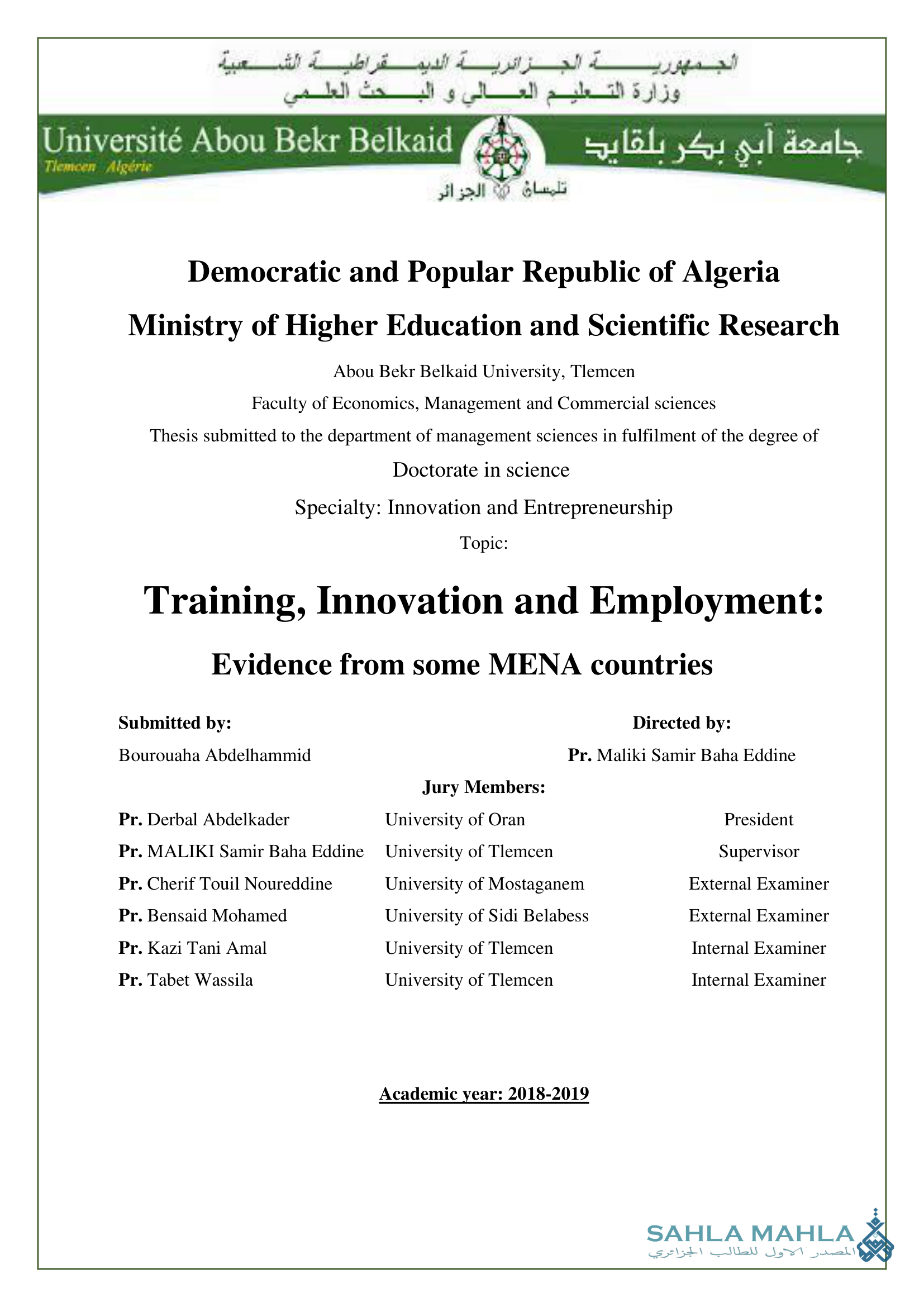
Outline:
General Introduction:
Statement of the problem and significance of the study:
Statement of the problem:
Research Hypotheses:
Aim of the thesis:
The significance (importance) of the study:
Chapter one: Human Capital and Economic Growth
Chapter Introduction:
Human capital: definitions; measuring and impacts:
What’s a human capital:
Measuring human capital:
Human capital theories and economic growth:
Romer model: knowledge spillover and growth
Uzawa-Lucas model: growth with education
Arrow-Lucas model: Growth and training
Factors affect human capital:
Education and human capital:
Migration (brain drain)
Looking for new job:
Gender and human capital:
Developing human capital:
The HCD “Human Capital Development”:
Economic and non-economic impacts of human capital:
Chapter Conclusion:
Chapter two: Training: Theory and Practice
Chapter Introduction:
The determinants and effects of training:
Training: Definition, approaches and Benefits
Training sub-themes:
Factors affecting training
Human capital and training:
Training and Education:
Education and training policies
The relationship between education and training:
Training and learning:
Training and sector of work:
Training and tourism
Training and hospitality industry:
Training and restaurant industry:
The creativity training:
Creativity program training:
Effectiveness of creative problem solving:
Evaluation of creativity training effectiveness research:
The need for further evidence on training delivery methods:
Chapter Conclusion:
Chapter Three: Links Between Innovation (national innovation system), Human capital (training) and employment:
Chapter Introduction:
Innovation and creativity:
Innovation: a multidisciplinary field of research
Theories of organizational creativity:
The componential theory of organizational creativity:
The interactionist approach
The componential interaction model – a unified view:
Different characteristics of innovation:
Levels of innovation:
Kinds of innovation:
Types of innovation:
Training and Innovation:
Skills employed in innovation:
Human capital as inputs of innovation process:
Skills and innovation in enterprises (organizations):
Innovation and labor markets changes:
Innovation and labor market flexibility:
Innovation and quality of labor:
Innovation and gender diversity:
Chapter Conclusion:
Chapter four: empirical research:
Chapter Introduction:
Characteristic of MENA region:
Characteristics of Innovation in MENA region:
National innovation system in MENA region:
Innovation and training in MENA region:
The global innovation index of the MENA region:
Innovation barriers:
Literature review:
Econometric model: Logit & Probit model
Logit model:
Probit model:
Testing econometric model:
Likelihood test:
P level:
Interpretation of the parameter:
Presentation of the variables:
Results and discussion:
Logit and probit estimation for innovation:
Logit and probit estimation for Product innovation:
Logit and probit estimation for organizational innovation:
Logit and probit estimation for marketing innovation:
Logit and probit estimation for logistic innovation:
Logit and probit estimation for process innovation:
Chapter Conclusion:
General Conclusion:
Policy recommendation:
Suggestion for future studies:
References:
Download The Thesis:
For more
academic sources and references,
including theses and dissertations from Algerian universities,
, visit our main website.