


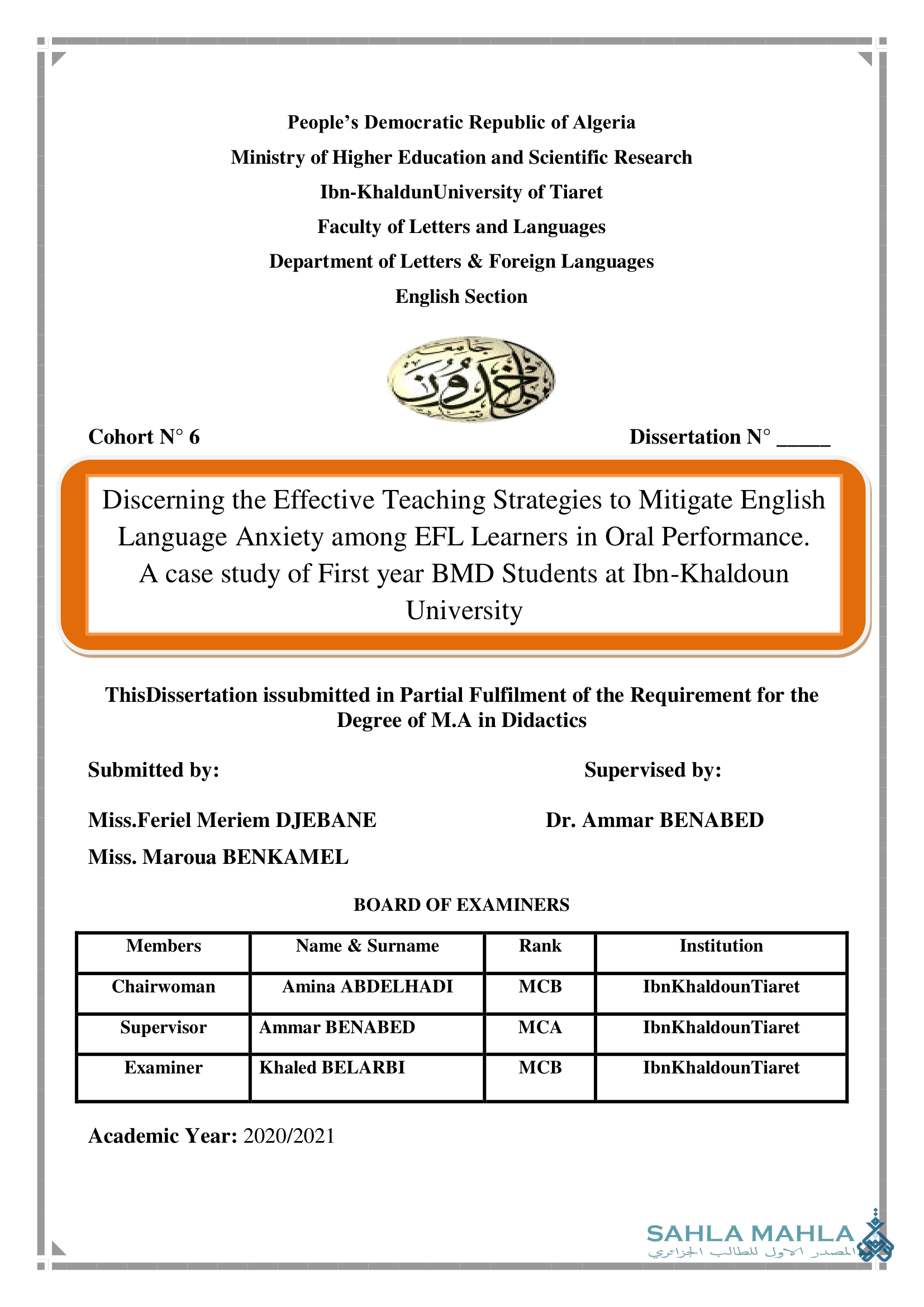
Discerning the Effective Teaching Strategies to Mitigate English Language Anxiety among EFL Learners in Oral Performance. A case study of First year BMD Students at Ibn-Khaldoun University
General Information:
Level |
Master |
Title |
Discerning the Effective Teaching Strategies to Mitigate English Language Anxiety among EFL Learners in Oral Performance. A case study of First year BMD Students at Ibn-Khaldoun University |
Specialty |
Didactics |
Cover Page:
Outline:
General Introduction
Statement of the Problem
Aim of the Study
Research Questions
Research hypotheses
Significance of the study
Research Design and Methodology
Research tools
The structure of the research
Delimitation of the study
Chapter One: Distinctive Features of Foreign Language Anxiety Terminology, Definitions, Causes
Introduction
I.1. Term Conceptualization and Definition
I.1.1. Anxiety Definitions
I.1.2.Anxiety types
I.1.2.1. Trait Anxiety (TA)
I.1.2.2. State Anxiety (SA)
I.1.2.3. Situation Specific Anxiety (SSA)
I.2. Foreign Language Learning Anxiety (FLLA)
1.2.1. Sources of Foreign Language Learning Anxiety
1.2.1.1. Communication Apprehension
1.2.1.2. Test Anxiety
1.2.1.3. Fear of Negative Evaluation
1.3. Foreign Language Learning Anxiety and the Affective Filter
1.4. Speaking anxiety
1.5. Factors Shaping Speaking anxiety
1.5.1. Gender
1.5.2. Low self-esteem
1.5.3. Competitiveness
1.5.4. Negative experience
1.5.4.1. Beliefs about the speakers of English
I.5.4.2. Beliefs about the four language skills
I.5.4.3. Beliefs about Teaching
I.5.4.4. Beliefs about appropriate classroom behaviour
I.5.4.5. Beliefs about Self
I.5.4.6. Beliefs about Goals
I.6. Anxiety
I.6.1. Indications of Anxiety
I.7.1. Physiological Symptoms
I.7.2. Psychological Symptoms
I.7.2.a. Behavioural Symptoms
I.7.2.b. Mental Symptoms
I.7.2.c. Affective Symptoms
I.8. Causes of Speaking Anxiety
I.8.1. Personal Causes
I.8.1.1. Weak Personality
I.8.1.2. Lack of Motivation
I.8.1.3. Lack of Vocabulary
I.8.1.4. Lack of Practice
I.8.1.5. Fear of being the Center of Attention
I.8.2. Interpersonal Causes
I.8.2.1. Laughing at Students’ Utterance
I.8.2.2. Competition
I.8.2.3. Teacher’s Behavior
I.9. The Classroom Levels
I.10. Effects of anxiety on the Speaking Skill
I.11. Anxiety and Motivation
I.11. Foreign Language setting
Conclusion
Chapter Two: The Effective Teaching Strategies to Mitigate Anxiety among EFL Learners
Introduction
II.1. Appropriate Atmosphere to Reduce FLA
II.2. Strategy Definition
II.2.1. Definition of Teaching Strategies
II.2.1.1. Different Types of Teaching Strategies to Reduce FLA
II.2.1.1.1.Brainstorming as a Strategy to Lessen Anxiety
II.2.1.1.2. Brainstorming Advantages
II.2.1.1.3. Brainstorming Drawbacks
II.2.1.2. Small-group Case-based Debate
II.2.1.3. Presentation as a Strategy to Mitigate Anxiety
II.2.1.3.1. Benefits of Presentations
II.2.1.3.2. Drawbacks of Presentations
II.2.1.4. Games
II.2.1.4.1. Games Advantages
II.2.1.4.2.Games Disadvantages
II.2.1.5. Independent Study
II.2.2. Characteristics of Teaching Strategies
II.2.2.1. Designing Project-work & Short-term Projects
II.2.2.2. Teachers’ Interventions to Reduce FLA
II.2.2.2.1. Establishing a Learning Community and a Supportive Classroom Atmosphere
II.2.2.2.2. Creating Teacher-students Relationship
II.2.2.2.3. Providing Indirect rather than Direct Correction
II.2.2.2.4. Accepting the Need for Self-worth Protection
II.2.2.2.5. Implementing Teacher Immediacy
II.2.2.2.6. Providing Praisals
II.2.3. Learners’ Strategies to Overcome their Anxiety
II.2.3.1. Psychological Strategies
II.2.3.1.1. Positive Thinking
II.2.3.1.2. Beforehand Preparation
II.2.3.1.3. Audience Analyzing
II.2.3.1.4. Clear Idea Organizing
II.2.3.1.5. Language Adapting
II.2.3.1.5. Real-life Scenarios Simulating
II.2.4. Pedagogical Strategies
II.2.4.1. Educators as Assistants to Students
II.2.4.2. Cognitive Restoration
II.2.4.3. Modelling and Directed Involvement
II.2.4.4. Setting up Appropriate Classroom Atmosphere
II.2.4.5. Activating EFL Teachers ‘Vital Role
II.2.5. Suggesting Tricks to EFL Teachers
II.2.5.1. Developing Effective Student-Teacher Relationships
II.2.5.2. Efficient Teaching Strategy Principles
Conclusion
Chapter Three: Empirical Part
Section One: Research Design and Methodology
III.1.Research Design
III.2.Case study approach
III.3.Quantitative-Qualitative
III.4.Sampling and Participants
III.5.Research Tools
III.5.1. Student s’ Questionnaire Description
III.5.2. Student s’ Questionnaire Objectives
III.5.3. Students’ Questionnaire Structure
III.5.4. Students’ Questionnaire Piloting procedure
III.5.5. Students’ Questionnaire Administration
III.6.1. Teachers’ Interview Description
III.6.2 Teachers’ Interview Objectives
III.6.3. Teachers’ Interview Structure
III.6.4. The Interview Piloting Procedure
Section Two: Data Analysis and Interpretation
III.7.1. Analysis and Interpretations of the Students’ Questionnaire
III.7.2. Analysis and Interpretation of the Teachers’ Interview
III.7.3. Discussion of the findings of the Students’ Questionnaire
III.7.4. Discussion of Teachers’ Interview Results
III.7.5 Triangulation of the Results
Conclusion
Limitations of the present study
Academic Implications and Recommendations
Recommendations for Students
Recommendations for Teachers
Recommondations for the Administraion
Recommondations for Future Researchers
General Conclusion
Bibliography
Download The Thesis:
For more
academic sources and references,
including theses and dissertations from Algerian universities,
, visit our main website.