

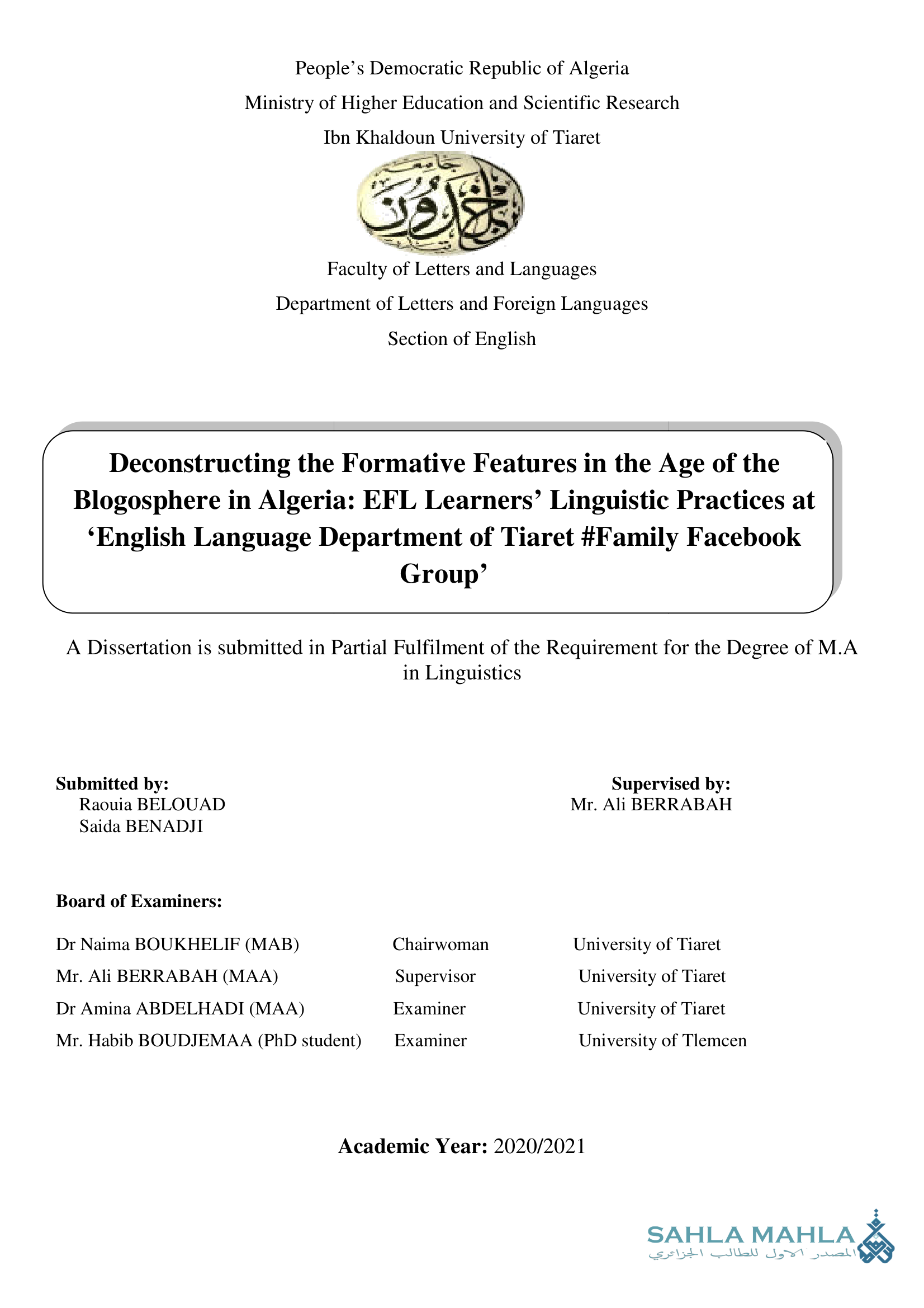
Deconstructing the Formative Features in the Age of the Blogosphere in Algeria: EFL Learners’ Linguistic Practices at ‘English Language Department of Tiaret #Family Facebook Group’
General Information:
Level |
PhD |
Title |
Deconstructing the Formative Features in the Age of the Blogosphere in Algeria: EFL Learners’ Linguistic Practices at ‘English Language Department of Tiaret #Family Facebook Group’ |
Specialty |
Linguistics |
Cover Page:
Outline:
Acknowledgements, Dedication, Table of Contents, List of Tables and Figures, List of Graphs, List of Abbreviations and Coding Conventions Used in the Dissertation, Key to Phonemic Transcription, Abstract, Abstract in Arabic, General Introduction, CHAPTER ONE: The Formative Features in Facebook Language as a Sociolinguistic Variables, 1.1 Introduction, 1.2 An Overview of Computer-mediated Communication, 1.2.1 Modes of Computer-mediated Communication, 1.2.1.1 Synchronous Computer-mediated Communication, 1.2.1.2 Asynchronous Computer-mediated Communication, 1.2.3 Synchronous vs. Asynchronous Computer-mediated Communication, 1.3 Relevant Computer-mediated Communication Theories, 1.3.1 Media Richness Theory, 1.3.2 Media Synchronicity Theory, 1.4 Computer-mediated Communication in Algeria, 1.5 The Origins of the Concept of Facebook, 1.5.1 Definition of Facebook, 1.5.2 Some aspects of Facebook, 1.5.3 The Concept of Neologisms on Facebook, 1.5.4 The Use of Emoticons in Facebook, 1.6 Formative Features, 1.6.1 Types of Formative Features, 1.6.1.1 Affixation: Derivational and Inflectional, 1.6.1.2 Back Formation, 1.6.1.3 Clipping (Abbreviation), 1.6.1.4 Blending, 1.6.1.5 Compounding, 1.6.1.6 Borrowing, 1.6.1.7 Coinage, 1.6.1.8 Acronyms, 1.6.1.9 Reduplication, 1.7 Conclusion, CHAPTER TWO: The Sociolinguistic Situation in Algeria, 2.1 Introduction, 2.2 Presentation of the Country Algeria, 2.2.1 Demography and Social structure, 2.3 The Berber and its Varieties, 2.4 An Overview on Arabic Language and its Varieties, 2.4.1 Classical Arabic, 2.4.2 Modern Standard Arabic, 2.4.3 Algerian Dialectal Arabic, 2.5 Foreign Languages in Algeria, 2.5.1 The Turkish Language, 2.5.2 The French Language, 2.5.3 The English Language, 2.5.4 The German Language, 2.5.5 The Spanish Language, 2.6 Outcomes of Language Contact Phenomena in Algeria, 2.6.1 Diglossia, 2.6.1.1 Diglossia in Algeria, 2.6.2 Code Switching, 2.6.2.1 Code Switching in Algeria, 2.6.3 Borrowing, 2.6.3.1 Borrowing in Algeria, 2.7 Tiaret: the Context of the Present Study, 2.7.1 A Geographical Overview, 2.7.2 The Sociolinguistic Situation in Tiaret, 2.7.3 The Linguistic Features of the Native Speakers of Tiaret, 2.8 Conclusion, CHAPTER THREE: Data Collection and Analysis, 3.1 Introduction, 3.2 Facebook as a Mode of Asynchronous Computer-mediated Communication, 3.2.1 The Choice of the Material from Facebook Group, 3.3 Methodology, Tools and Sampling, 3.4 Description of the Questionnaire, 3.5 Analysis of Questionnaire’ Findings, 3.5.1 Personal Information, 3.5.2 Linguistic Baggage and Language Choice, 3.5.3 Attitudes towards Language Use on the Facebook, 3.6 Analysis of Qualitative Observation, 3.7 Data Collection Procedures (Description of the Facebook Group English Language Department of Tiaret #Family), 3.8 Findings and Discussion, 3.8.1 Discussion of the findings, 3.9 Conclusion, General conclusion, Bibliography, Appendices, Maps and illustrations, Questionnaire
Download The Thesis:
For more
academic sources and references,
including theses and dissertations from Algerian universities,
, visit our main website.