


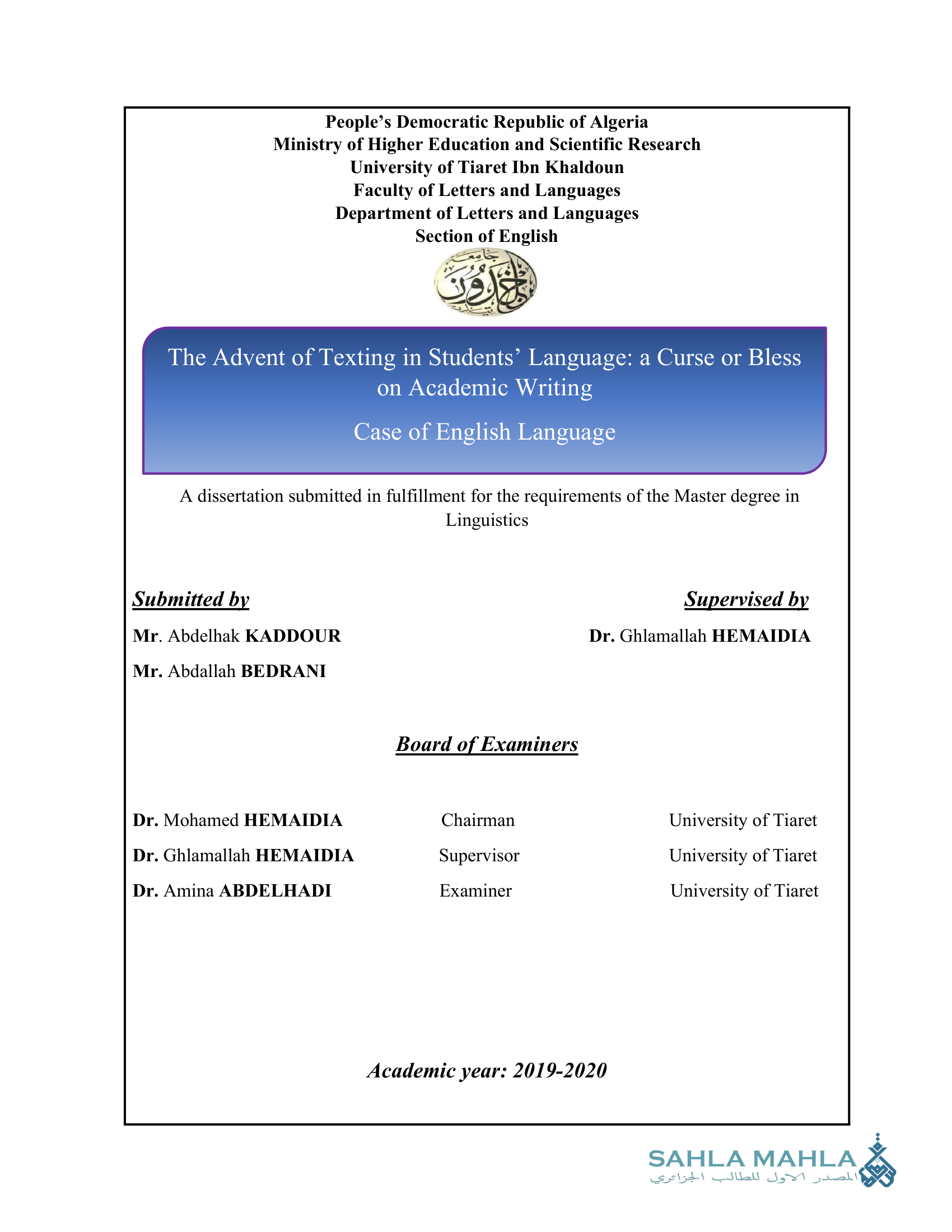
The Advent of Texting in Students’ Language: a Curse or Bless on Academic Writing Case of English Language
General Information:
Level |
Master |
Title |
The Advent of Texting in Students’ Language: a Curse or Bless on Academic Writing Case of English Language |
Specialty |
Linguistics |
Cover Page:
Outline:
General Introduction
Chapter One: Fundamentals of Texting
1. Introduction
2. Texting
2.1. Linguistic features of texting
2.1.1. Shortenings (acronyms, initialisms, clipping and blending)
2.1.2. Number / letter homophones and symbols
2.1.3. Contractions and Colloquial contractions
2.1.4. Consonant spelling and double-letter reduction
2.1.5. Emotions and humor with letters and emoticons
2.2. Texting vs. Ancient writing systems
3. Previous studies on texting
4. Recent Studies on texting
5. Systematism in texting (codifiability of texting)
6. The use of textese by students
7. The effects of textese on grammar, spelling and punctuation
8. Academic writing and texting
8.1. Academic writing
8.2. Features of academic writing
8.3. Texting vis-à-vis academic writing style
9. Conclusion
Chapter Two: Field Work
2.1 Introduction
2.2 Aim of The Study
2.3 Methodology
2.3.1 Student-addressed questionnaire
2.3.1.1 Questionnaire in details
2.3.1.2 The questionnaire sample
2.3.1.3 Pilot study
2.3.1.4 Questionnaire results
2.3.1.5 Preliminary reading in the questionnaire results
2.3.2 Teacher-addressed interview
2.3.2.1 Interview in details
2.3.2.2 Interview sample
2.3.2.3 Interview results
2.3.2.4 Preliminary readings of the interview results
2.4 Conclusion
Chapter Three: Recommendations and Suggestions
3.1 Introduction
3.2 Readings and Insights in Questionnaire Results
3.2.1 Students’ flexibility of using Social Networking
3.2.1.1 Students’ use of messaging applications
3.2.1.2 English usage in Social Networking
3.2.2 The potential effects of texting on students’ overall literacy
3.2.2.1 The effects of texting on students’ systematic grammar
3.2.2.2 The effect of texting on students’ systematic spelling
3.2.2.3 The effect of texting on students’ systematic punctuation
3.2.3 Texting appearance in students’ academic productions
3.2.3.1 The awareness of students towards formal and informal writing
3.2.3.2 The effect of autocorrect and predicative features
3.2.3.3 Students’ deficiencies in the language systems
3.2.4 Texting contribution in students’ literacy abilities
3.2.4.1 The contribution of texting in students’ reading and writing abilities
3.2.4.2 Texting motivation in enriching students’ vocabulary background
3.2.4.3 The phonological awareness with the help of texting
3.2.4.4 Students’ attitude towards the incorporation of texting in academic context
3.3. Readings and insights in the interview results
3.3.1 The importance of academic strict criteria
3.3.1.1 Teachers’ attitude towards students’ way of speaking
3.3.1.2 The interference of informal style in students’ examination papers
3.3.1.3 Students’ deficiencies in grammar
3.3.1.4 The influence of French language on English spelling
3.3.1.5 Teachers’ attitude towards grammar and spelling mistakes
3.3.2 The reasons behind using such a deteriorated academic language by students
3.3.2.1 Negative language interference
3.3.2.2 Students’ exposure to informal language Negative technological interference
3.3.2.3 Students’ Abstention from Reading Formal Texts
3.3.2.4 Students’ Abstention from Making Efforts to Learn
3.3.2.5 Students’ lack of basic teachings of English in previous stages of education
3.3.3 From the habit of making mistakes to mistakes being the norm
3.3.3.1 Developing mistakes as learners’ repertoire
3.3.3.2 The impact of deteriorated language as habit on academic context
3.3.4 The potentials of texting getting approved in academic writing
3.3.4.1 The importance of academic features
3.3.4.2 The emergence of texting as a new style
3.4. Conclusion
General conclusion
References
Download The Thesis:
For more
academic sources and references,
including theses and dissertations from Algerian universities,
, visit our main website.