


Artificial Neural Networks for a Hybrid Recommendation System
General Information:
Level |
Master |
Title |
Artificial Neural Networks for a Hybrid Recommendation System |
Specialty |
Génie logiciel |
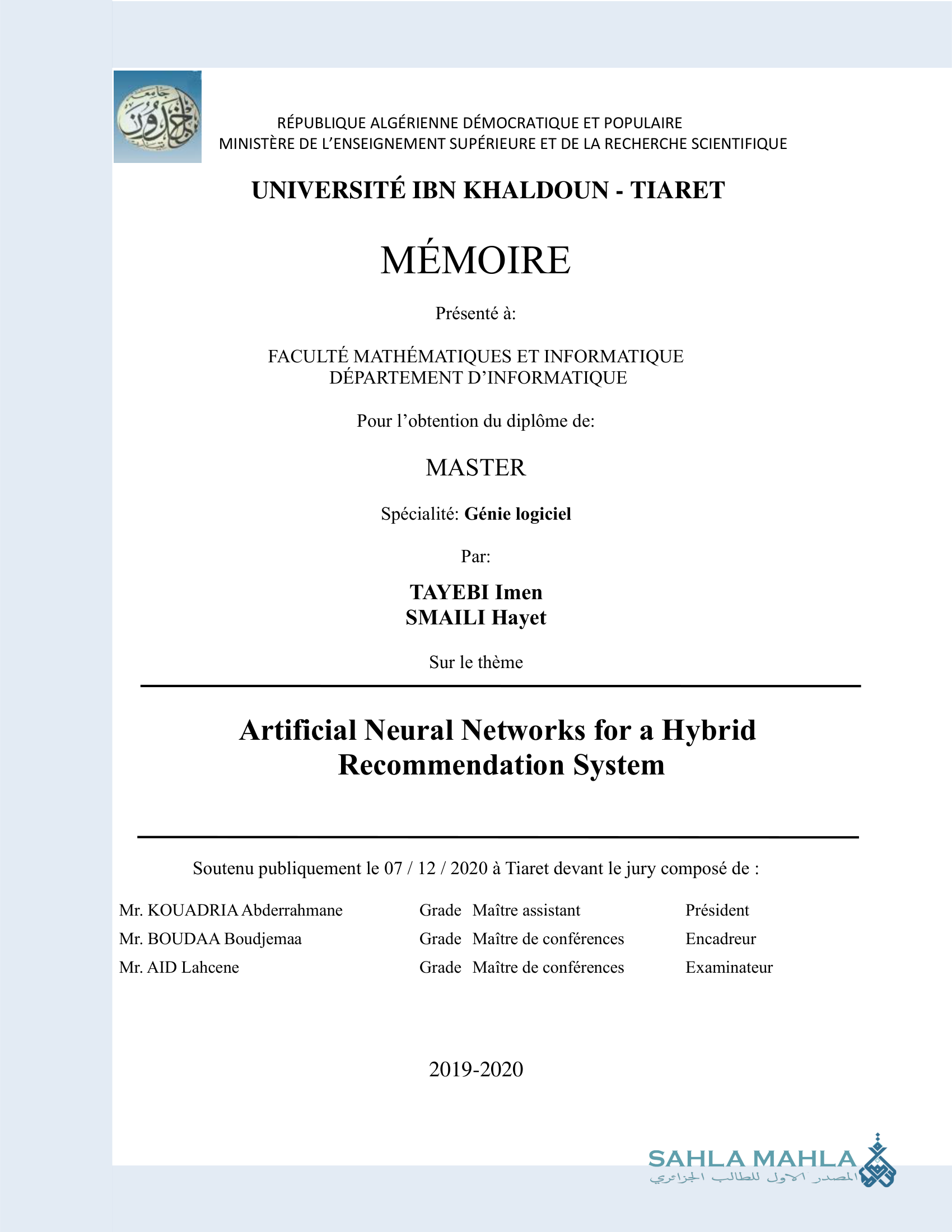
Cover Page:
Outline:
General introduction
1 Background and Problem Statement
2 Approach
3 Outline
Chapter-1- Hybrid recommender systems
1. Introduction
Recommender System techniques
1.3 Collaborative Filtering Recommender System
1.3.1 Memory-based approaches
1.3.1.1 User-Based Approach
1.3.1.2 Item-Based Approach
1.3.2 Model based approaches
1.4 Content-Based Recommender System
1.5 Hybrid Recommender System
Comparison of existing Recommender System techniques
A hybrid recommendation system using Content-based and Collaborative filtering
1.6 Weighted
Different Hybridization Methods
1.7 Switching
1.8 Mixed Method
1.9 Feature Combination
1.10 Cascade
Feature Augmentation
Meta-level
Challenges and Issues
1.11 Cold-Start Problem
1.12 Data-Sparsity
1.13 Scalability
1.14 Gray Sheep
10. Conclusion
Chapter 2 – Artificial neural networks
1. Introduction
Background
2.1 Machine Learning
2.1.1 Need for Machine Learning
2.1.2 Why Machine Learning Matters
2.1.3 When Should You Use Machine Learning
2.1.4 Types of Machine Learning
2.2 Deep Learning
2. Artificial Neural Network
2.3 What is a neural network
2.4 ANN versus BNN
2.5 How do artificial neural nets model the brain
2.6 Main Architectures of Artificial Neural Networks
2.7 Activation functions
2.7.1 Types of Activation Functions
2.7.2 Common Nonlinear Activation Functions
2.8 The Backward Propagation Algorithm
2.9 Types of ANNs
2.10 Potential Application Areas
2.11 Advantages and disadvantages of ANN
3. Conclusion
Chapter – 3 – A hybrid recommender system using artificial neural networks
1. Introduction
2. Artificial neural network for Hybrid Recommendation System
2.1 Artificial neural network – supervised learning Model
2.2 A feedforward neural network
Experiments
2.3 Data Model
2.4 Implementation
2.4.1 Language and libraries
2.4.1.1 R Language
2.4.1.2 Python Language
2.4.1.3 Keras
2.4.1.4 TensorFlow
2.4.1.5 Scikit-learn
2.5 Running Environment
2.5.1 Anaconda
2.5.2 Spyder
2.6 Results and Discussion
5. Conclusion
General Conclusion
1 Summary
2 Limitations
3 Future work
Bibliography
Download The Thesis:
For more
academic sources and references,
including theses and dissertations from Algerian universities,
, visit our main website.