


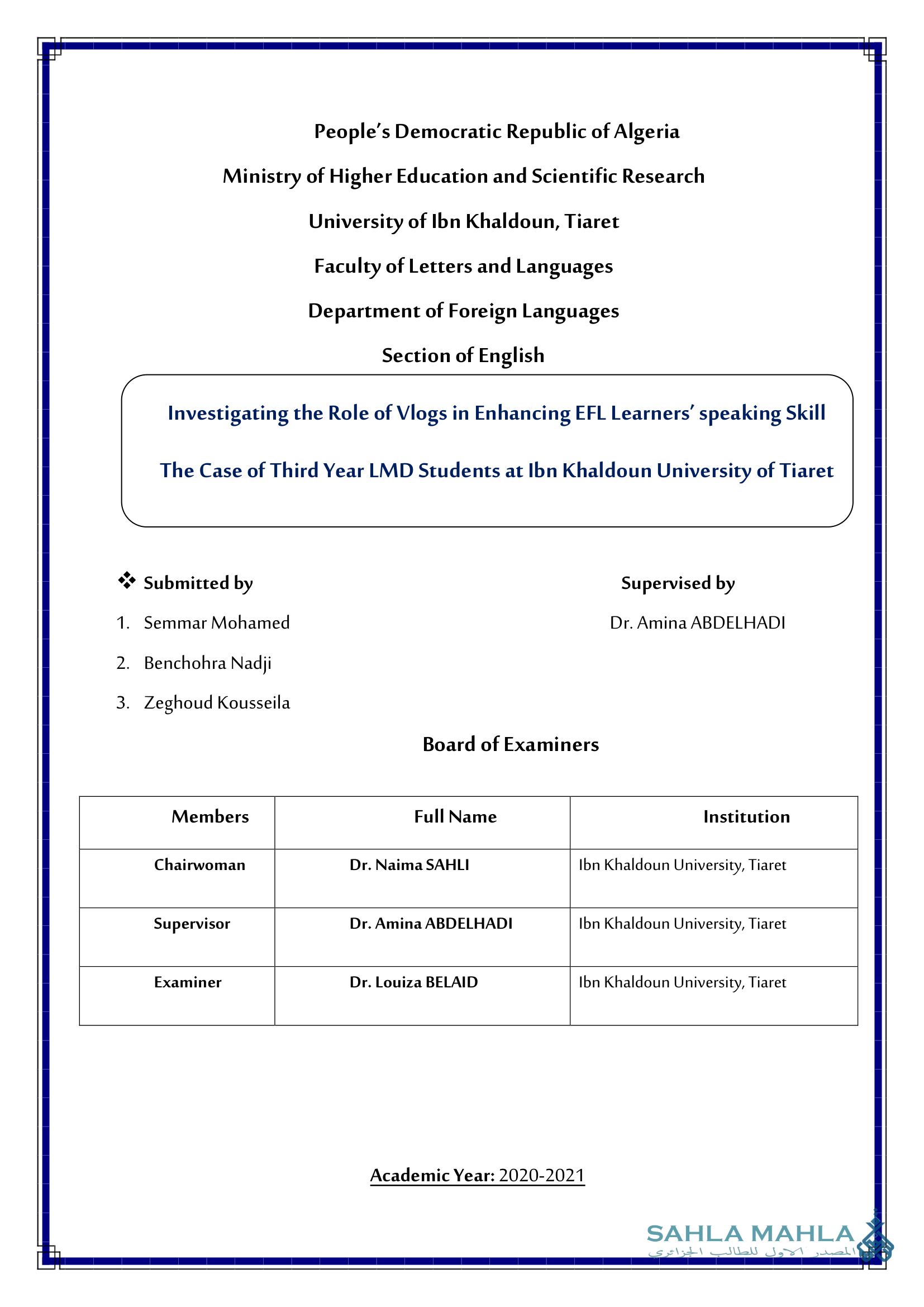
Investigating the Role of Vlogs in Enhancing EFL Learners’ speaking Skill The Case of Third Year LMD Students at Ibn Khaldoun University of Tiaret
General Information:
Level |
Master |
Title |
Investigating the Role of Vlogs in Enhancing EFL Learners’ speaking Skill The Case of Third Year LMD Students at Ibn Khaldoun University of Tiaret |
Specialty |
Applied Linguistics / TEFL |
Cover Page:
Outline:
Dedications, Acknowledgments, Abstract, List of abbreviations, List of Figures, Table of Content, General Introduction, 1. Research Motivations, 2. Research Aims, 3. Significance of the Study, 4. Research Questions, 5. Research Hypotheses, 6. Research Methodology, 7. Research Process, Chapter One: Social Media and English language Learning, 1.1. Introduction, 1.2. The use of Technology inside the Classroom, 1.3. Authentic Materials in teaching, 1.4. Social Media, 1.5. Uses of Social Media for Improving English Learning Skills, 1.6. Relationship between Learning Theories and Social Media Platforms in the Field of English Learning Skills, 1.6.1. Online Collaborative Learning Theory, 1.6.2. Connectivism Model, 1.6.3. Functionalist Theory, 1.7. Social Media and Social Change, 1.8. Comparison, 1.9. YouTube, 1.9.1. Definition, 1.9.2. Historical Background of YouTube, 1.9.3. YouTube Video in Teaching Foreign Language, 1.9.4. Purpose of Using YouTube Videos in Foreign Language Teaching, 1.10 Conclusion, Chapter Two: Speaking Skill, 2.1. Introduction, 2.2.1. Knowledge and Skill, 2.3. The Importance of Speaking Skill, 2.4. The Components of Speaking Skill, 2.4.1. Fluency, 2.4.2. Accuracy, 2.4.3. Grammar, 2.4.4. Pronunciation, 2.4.5. Vocabulary, 2.5. Teaching Speaking Skill, 2.5.1. Difficulties in Teaching Speaking Skill, 2.5.2. Goals of Teaching Speaking, 2.5.3. Speaking Activities, 2.6. Roles of Studentsin Learning Speaking, 2.6.1. Imitative, 2.6.2. Intensive, 2.6.3. Responsive, 2.6.4. Transactional, 2.6.5. Interpersonal, 2.6.6. Extensive, 2.7. Communicative Language Teaching, 2.7.1. Origins, 2.7.2. Definition, 2.7.3. Communicative Competence, 2.8. Modern Technologies in Teaching Speaking Skill, 2.8.1. Communication lab, 2.8.2. Video Conferencing, 2.8.3. Video Library, 2.8.4. CALL (Computer Assisted Language Learning), 2.8.5. TELL (Technology Enhanced Language Learning), 2.8.6. Pod Casting, 2.8.7. Quick Link Pen, 2.8.8. Quicktionary, 2.8.9. Educational Satellites, 2.8.10. Speech Recognition Software, 2.8.11. Internet, 2.8.12. Blogging, 2.9. Conclusion, Chapter Three:Data Collection, Data Analysis and Interpretation, 3.1. Introduction, 3.2. Research Design, 3.2.1. Triangulation, 3.2.2. Mixed method: Quantitative vs. Qualitative Approach, 3.3. Setting, Population and Sampling of the Study, 3.3.1 Setting, 3.3.2. Population, 3.3.3. Sampling, 3.4. Data Collection Instruments, 3.4.1. Description of the Questionnaire, 3.4.2. Description of the Interview, 3.5. The pilot study, 3.6. Data Analysis and Interpretation, 3.6.1 The Analysis of the Questionnaire, 3.6.3. The Analysis of the Interview, 3.6.5. Synthesis of the Findings, 3.6.6. Recommendations, 3.6.7. Limitations, 3.6.8. Conclusion, General Conclusion, References, APPENDICES, Appendix I, Appendix II, General Introduction, 1. Research Motivations, 2. Research Aims, 3. Significance of the Study, 4. Research Questions, 5. Research Hypotheses, 6. Research Methodology, 7. Research Process, Abstract, Résumé
Download The Thesis:
For more
academic sources and references,
including theses and dissertations from Algerian universities,
, visit our main website.