


Comportement en solutions aqueuses du système copolymère cationique/ SDS (P4VP modifiés/SDS) – Influence du degré de neutralisation
Des informations générales:
Le niveau |
Magistère |
Titre |
Comportement en solutions aqueuses du système copolymère cationique/ SDS (P4VP modifiés/SDS) – Influence du degré de neutralisation |
SPECIALITE |
Chimie et Physico-chimie Organique Macromoléculaire |
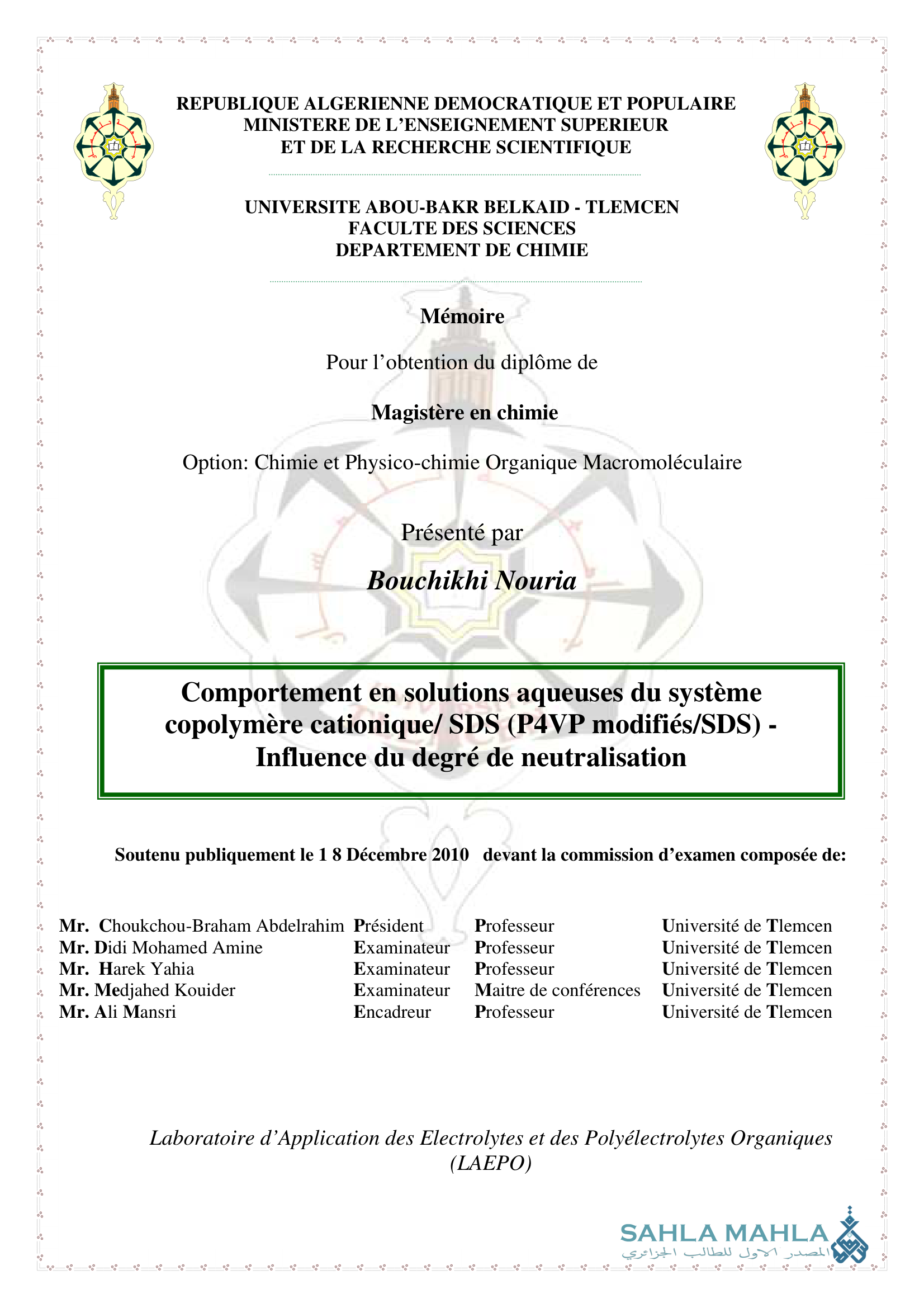
Page de garde:
Sommaire:
Chapitre I: Rappels sur les polymères
1.1. INTRODUCTION
1.2. POLYMERES EN SOLUTION
1.2.1. Polymères neutres
1.2.2. Polyélectrolytes
1.2.3. Les polymères modifiés hydrophobes
1.3. RAPPELS SUR LE POLY(4-VINYLPYRIDINE) (P4VP)
Chapitre II: Interaction polymère- tensioactifs analyse bibliographique
II.1. GENERALITES SUR LES TENSIOACTIFS
II.2.TENSION DE SURFACE ET CONCENTRATION MECILLAIRE CRITIQUE
II.2.1 Tension de surface
II.2.2 Comportement des tensioactifs dans l’eau
II.2.3 Mesure de la CMC
II.2.4 Paramètres influençant la concentration micellaire critique
II.2.5. Tensioactif utilisé
II.3. INTERACTION POLYMERE TENSIOACTIF.
II.3.1 Introduction
II.3.2 Concentration d’agrégation critique CAC et PSP
II.3.3 Paramètres influençant la complexation polyelectrolyte-tensioactif
II.3.4 Moyens d’investigation
II.3.5 Interactions polyélectrolytes modifiés hydrophobest-tensioactifs
II.3.6 les complexes P4VP modifié hydrophobe -tensioactifs
Chapitre III: Techniques expérimentales
III.1. VISCOSIMETRIE
III.2. CONDUCTIMETRIE
III.3. TENSIOMETRIE
III.4.LA SPECTROSCOPIE INFRA ROUGE A TRANSFORMATION DE FOURIER(FTRI)
III.5. RESONANACE MAGNETIQUE NUCLEAIRE
III.6. DIAGRAMMES DE PHASES
Chapitre IV: partie expérimentale
IV.I.1.Synthèse du p4vp
IV.I.2.Caracterisation du P4VP
IV.I.3.Quaternnisation de p4vp avec le bromohexane
IV.I.4.Caractérisation des copolymères P4VPC6Br
IV.II.1 Introduction
IV.II.2. produits utilisés
IV.II.3. préparation des solutions
IV.II.4.ETUDE DU COMPORTEMENT DES P4VPC6(s) ET DU P4VP-HCl
IV.II.4.1.Etude viscosimétrique
IV.II.4.2. Etude conductimétrique.
IV.II.4.3.Etude tensiométrique
IV.II.5. ETUDE DU COMPORTEMENT DU SDS
IV.II.5.1. Etude tensiométrique
IV.II.5.2. Etude conductimétrique
IV.II.5.3 Etude viscosimétrique
IV. II.6. ETUDE DU COMPORTEMENT DES MELANGE P4VPC6Br SDS
IV.II.6.1. Diagrammes de phases
IV.II.6.2. Etude tensiométrique
IV.II.6.3 Etude conductimétrique
IV.II.6.4 .Etude viscosimétrique
IV.II.7. l’effet de l’agent alkyant sur l’interaction P4VP – SDS
IV.II.7.1.Etude tensiométrique
IV.II.7.2.Etude conductimétrique
IV.II.7.3.étude viscosimétrique
1.1. INTRODUCTION
1.2. POLYMERES EN SOLUTION
1.2.1. Polymères neutres
1.2.2. Polyélectrolytes
1.2.3. Les polymères modifiés hydrophobes
1.3. RAPPELS SUR LE POLY(4-VINYLPYRIDINE) (P4VP)
Chapitre II: Interaction polymère- tensioactifs analyse bibliographique
II.1. GENERALITES SUR LES TENSIOACTIFS
II.2.TENSION DE SURFACE ET CONCENTRATION MECILLAIRE CRITIQUE
II.2.1 Tension de surface
II.2.2 Comportement des tensioactifs dans l’eau
II.2.3 Mesure de la CMC
II.2.4 Paramètres influençant la concentration micellaire critique
II.2.5. Tensioactif utilisé
II.3. INTERACTION POLYMERE TENSIOACTIF.
II.3.1 Introduction
II.3.2 Concentration d’agrégation critique CAC et PSP
II.3.3 Paramètres influençant la complexation polyelectrolyte-tensioactif
II.3.4 Moyens d’investigation
II.3.5 Interactions polyélectrolytes modifiés hydrophobest-tensioactifs
II.3.6 les complexes P4VP modifié hydrophobe -tensioactifs
Chapitre III: Techniques expérimentales
III.1. VISCOSIMETRIE
III.2. CONDUCTIMETRIE
III.3. TENSIOMETRIE
III.4.LA SPECTROSCOPIE INFRA ROUGE A TRANSFORMATION DE FOURIER(FTRI)
III.5. RESONANACE MAGNETIQUE NUCLEAIRE
III.6. DIAGRAMMES DE PHASES
Chapitre IV: partie expérimentale
IV.I.1.Synthèse du p4vp
IV.I.2.Caracterisation du P4VP
IV.I.3.Quaternnisation de p4vp avec le bromohexane
IV.I.4.Caractérisation des copolymères P4VPC6Br
IV.II.1 Introduction
IV.II.2. produits utilisés
IV.II.3. préparation des solutions
IV.II.4.ETUDE DU COMPORTEMENT DES P4VPC6(s) ET DU P4VP-HCl
IV.II.4.1.Etude viscosimétrique
IV.II.4.2. Etude conductimétrique.
IV.II.4.3.Etude tensiométrique
IV.II.5. ETUDE DU COMPORTEMENT DU SDS
IV.II.5.1. Etude tensiométrique
IV.II.5.2. Etude conductimétrique
IV.II.5.3 Etude viscosimétrique
IV. II.6. ETUDE DU COMPORTEMENT DES MELANGE P4VPC6Br SDS
IV.II.6.1. Diagrammes de phases
IV.II.6.2. Etude tensiométrique
IV.II.6.3 Etude conductimétrique
IV.II.6.4 .Etude viscosimétrique
IV.II.7. l’effet de l’agent alkyant sur l’interaction P4VP – SDS
IV.II.7.1.Etude tensiométrique
IV.II.7.2.Etude conductimétrique
IV.II.7.3.étude viscosimétrique
Télécharger:
Pour plus de
sources et références universitaires
(mémoires, thèses et articles
), consultez notre site principal.