


Using Video Conferences for ESP Postgraduate Students: An Example of Distance Learning At the University Of Abou Bakr Belkaid- Tlemcen
General Information:
Level |
Magister |
Title |
Using Video Conferences for ESP Postgraduate Students: An Example of Distance Learning At the University Of Abou Bakr Belkaid- Tlemcen |
Specialty |
English for Specific Purposes |
Cover Page:
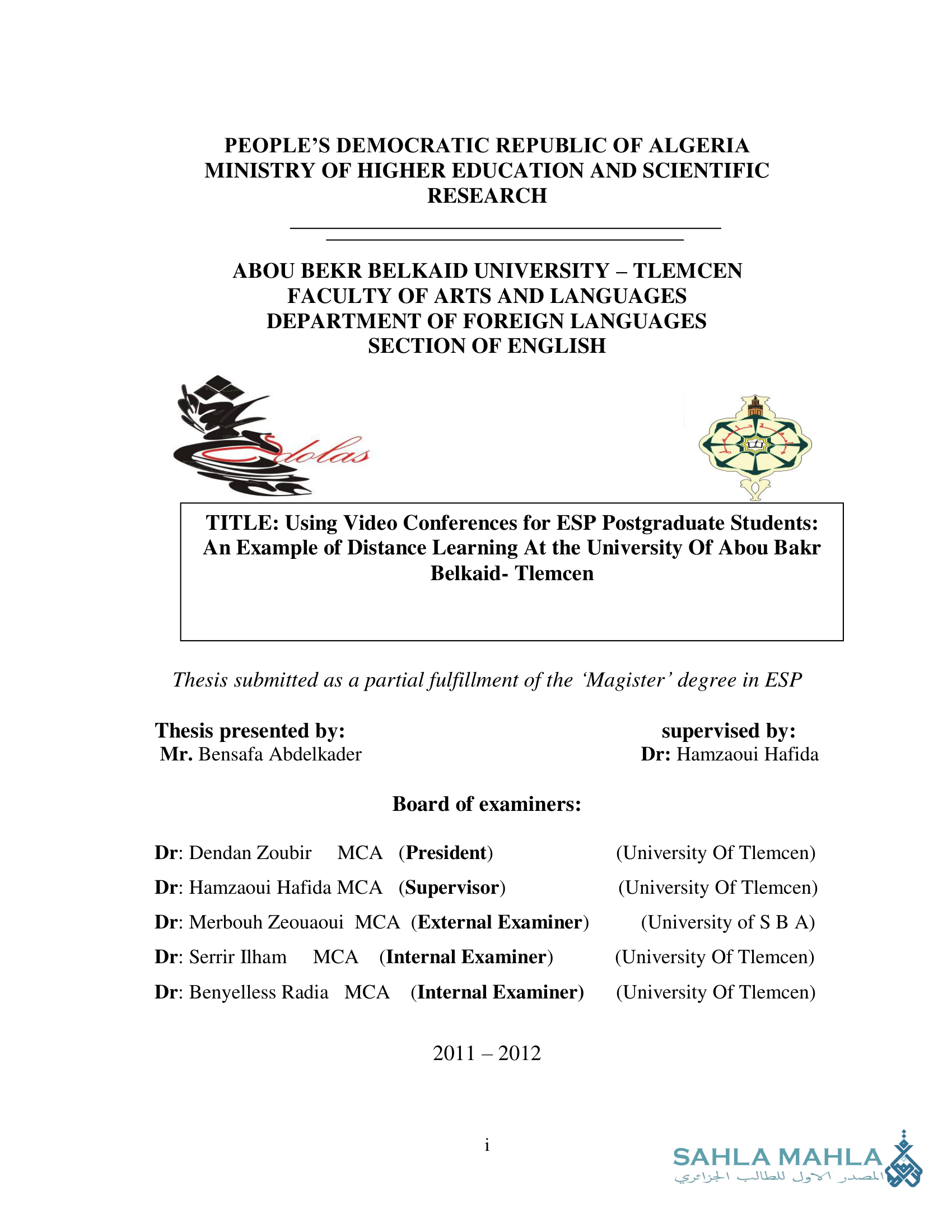
Outline:
Acknowledgments
Abbreviations and acronyms
General introduction
Chapter One: The Role of ICT in Foreign Language Teaching
1.1. Introduction
1.2. Expanding Access to education through ICT
1.2.1 Promoting Efficiency of Language Teaching
1.2.2 Promoting Student-Centered Curricula
1.2.3 Improving the Quality of Learning
1.2.3.1 Learning Time vs. Classroom Time
1.2.3.2 Motivating to Learn
1.2.4 Fostering Inquiry and Exploration
1.2.5 The Changing Roles of Language Teachers
1.2.6 ICT as a Foreign Language Teaching Support
1.2.7 ICT and the Teaching of ESP
1.2.7.1 Authentic Resources Used in ESP Learning
1.2.7.2 The impact of ICT Tools Used in Learning ESP
1.3 Video Conferencing
1.3.1 Definition of Video Conferencing
1.3.2 Functionality
1.4 ICT in Algerian Education
1.4.1 The Algerian Educational System
1.4.2 ICT Policies in Algeria
1.4.3 ICT Environment in Algerian Education
1.4.4 Training Professionals on Teaching and Usage of ICT in Algeria
1.4.5 Implementing ICT in Algerian Education
1.4.6 Video Conferencing and the Teaching of ESP in Algeria
1.5 Conclusion
Chapter Two: Research Design and Procedures
2.1 Introduction
2.2 Research Design
2.3 Research approach
2.3.1 Qualitative Approach
2.3.2. Quantitative Approach
2.4. Data Collection
2.4.1. Setting
2.4.2. Hardware
2.4.3. Procedure
2.4.3.1 Participants’ profile
2.4.3.2. Video Conferences Procedures
2.5 Instruments
2.5.1 Semi- Structured Interview
2.5.2 Participant Observation
2.6 Data Analysis
2.6.1 Qualitative Data Analysis
2.6.2 Quantitative Data Analysis
2.7 Conclusion
Chapter There: Data Analysis and Interpretation
3.1 Introduction
3.2 Analysis of the Interview
3.2.1 Procedure
3.2.2 Results
3.2.2.1 The technology used in the video conference
3.2.2.2 Content delivery
3.2.2.3 Students’ attitudes and perceptions
3.3 Analysis of Participant Observation
3.3.2.3 Content delivery
3.3.1 Procedure
3.3.2 Results
3.3.2.1 Description of the setting and participants
3.3.2.2 The technology used in the video conference
3.3.2.4 Students’ attitudes and perceptions
3.4 Discussion and Interpretation of the Main Results
3.5 Conclusion
Chapter four: Suggestions and Recommendations for the Use of Video Conference
4.1 introduction
4. 2 Pedagogical applications of video-conferencing
4.2.1 Advantages of pedagogical use of video conference
4.2.2 Enhancing the use of video conference
4.3.1.1 The role of the technician
4.3 Preparing good conditions for the use of video conference
4.3.1 Technical preparation for video conferences
4.3.1.2 the visual display equipment
4.3.1.3 Preparing the room and equipment
4.3.2 Teachers’ preparation for video conference
4.3.3 Students’ preparation for video conference
4.4 limitations of video conference
4.4.1 General limitations
4.4.2 Limitations for education
4.4.3 Limitations in organizations
4.5 Recommendations for a better use of video conference
4.5.1 Recommendations to teachers
4.5.2 Recommendations to administration
4.5.3 Recommendations to learners
4.6 Conclusion
General conlusion
Bibliography
Download The Thesis:
For more
academic sources and references,
including theses and dissertations from Algerian universities,
, visit our main website.