


INVESTIGATING THE GAP BETWEEN EXPECTATION AND REALITY IN REFLECTIVE TEACHING: SECONDARY SCHOOL TEACHERS AS A STUDY CASE
General Information:
Level |
Master |
Title |
INVESTIGATING THE GAP BETWEEN EXPECTATION AND REALITY IN REFLECTIVE TEACHING: SECONDARY SCHOOL TEACHERS AS A STUDY CASE |
Specialty |
Didactics |
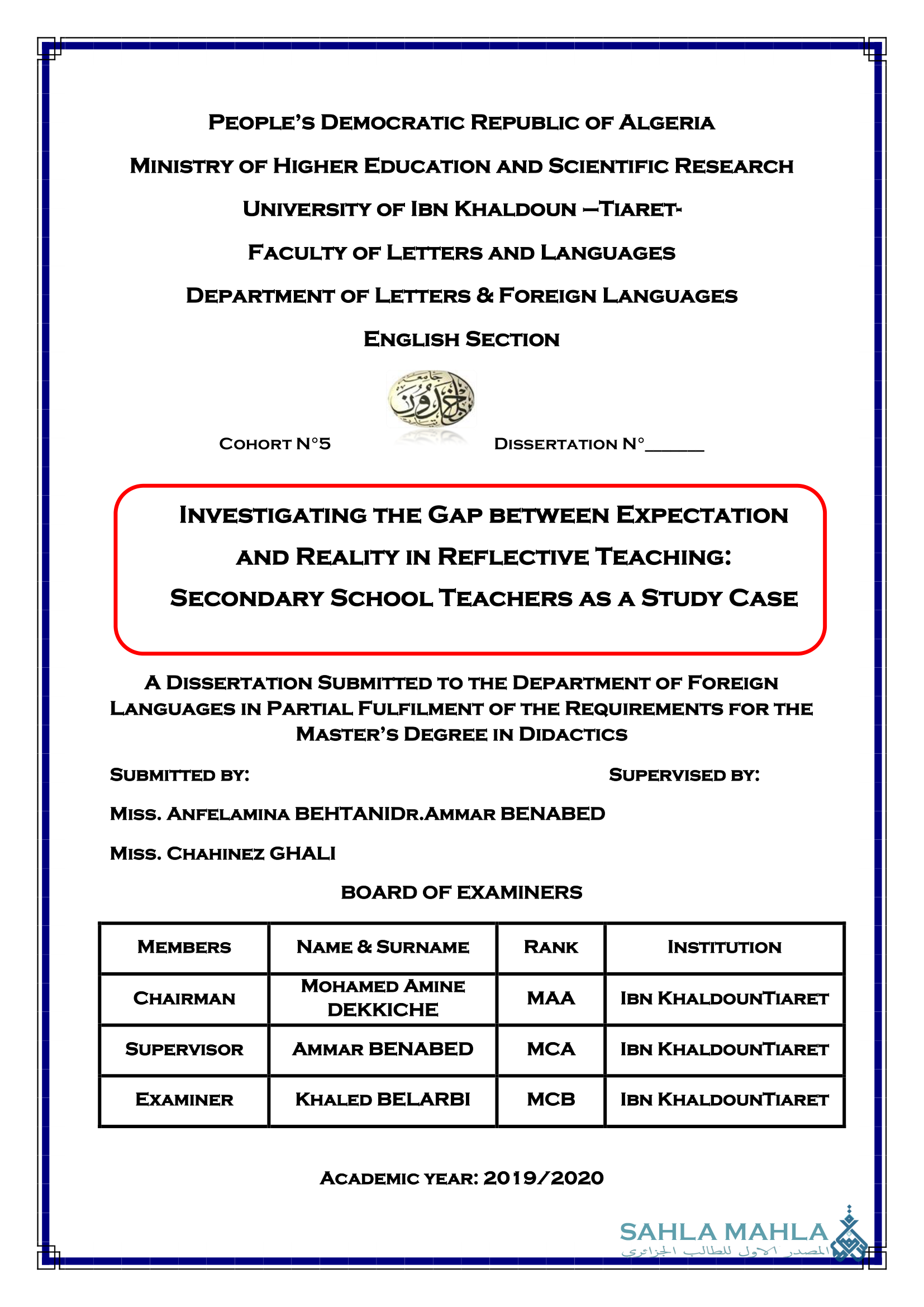
Cover Page:
Outline:
GENERAL INTRODUCTION
I.1 Definition of Reflection
I.2 The Purpose of Reflection.
I.3 Milestones of the Concept of Reflection
I.3.1 John Dewey and Reflection (1859-1952)
I.3.2 Donald Schön (1930-1997), Reflection-in-Action and Reflection-on-Action
I.4 Definition of Reflective Practice
I.5 Purposes of Reflective Practice
I.6 The Execution of Reflective Teaching in the teaching Classroom
I.7 Tools of Reflection
I.7.1 Journal Writing
I.7.2 Lesson Reports
I.7.3 Surveys and Questionnaires
I.7.4 Audio or Video Recording Lessons
I.7.5 Observation
I.7.6 Action Research
I.8 Review of Previous Studies on Reflective Practice in Language Classroom
I.8.1 Effect of Reflective Teaching Practices on the Performance of Prospective Teachers
I.8.2 Reflective Teaching: an Approach to Enrich the English Teaching Professional Practice
I.8.3 Use of Reflective Journals in Development of Teachers’ Leadership and Teaching Skills
I.8.4 The Role of Critical Reflection in Teacher Education
I.8.5 Reflective Teaching Practice in an EFL Context: A Qualitative Study
I.8.6 Attitudes towards Reflective Practice: Emerging Findings from a TQEF Study
I.8.7 Reflective Teaching Practices in Teachers and their Attitudes toward Professional Self-development
I.8.8 Writing to Learn: Can Reflection Journals Be Used to Promote Self-reflection and Learning?
I.8.9 Reflective Teaching Model: A Tool for Motivation, Collaboration, Self-reflection, and Innovati
I.8.10 Reflective Teaching Practice among Student Teachers: The Case in a Tertiary Institution in Nigeria
Conclusion
Introduction
II.1 English as an International Language
II.2 Status of English in Algeria
II.3 Teaching English as Foreign Language in Algeria
II.3.1 Objectives of Teaching English as Foreign Language in Algeria
II.3.2 Methods of Teaching English as a Foreign Language in Algeria
II.3.3 Finalities of Teaching English as a Foreign Language in Algeria
II.4 Algerian Educational System
II.4.1 Primary Education
II.4.2 Middle School Education
II.4.3 Secondary School Education
II.4.4 Higher Education
II.5 Competency-based Approach (CBA)
II.5.1 Competency-based Approach in Algerian Secondary Education
II.5.2 Challenges of Applying the Competency-based Approach in Practicing Reflective Teaching in the Algerian Educational
Conclusion
Introduction
III.1 Research Design
III.2 Population and Sampling
III.3 Research Procedure
III.3.1 Pilot Study
III.3.2 The Study Proper
III.4 Research Instruments
III.4.1 Quantitative Tool
III.4.2 Qualitative Tools
III.5 Data Analysis and Interpretation
III.5.1 Analysis of Teachers’ Questionnaire
III.5.2 Data Interpretation of Teachers’ Questionnaire
III.5.3 Analysis of Teachers’ Structured Interview
III.5.4 Interpretation of Teachers’ Structured Interview
III.5.5 Teachers’ Daily Copybook Analysis
III.5.6 Interpretation of Teachers’ Daily Copybook
III.6 Data Interplay
Conclusion
GENERAL CONCLUSION
REFERENCES
Download The Thesis:
For more
academic sources and references,
including theses and dissertations from Algerian universities,
, visit our main website.