


Machiavellian Policy and its Impact on Nowadays Political Leaders According to The Prince
General Information:
Master |
Level |
Machiavellian Policy and its Impact on Nowadays Political Leaders According to The Prince |
Title |
English Literary and Cultural Studies |
Specialty |
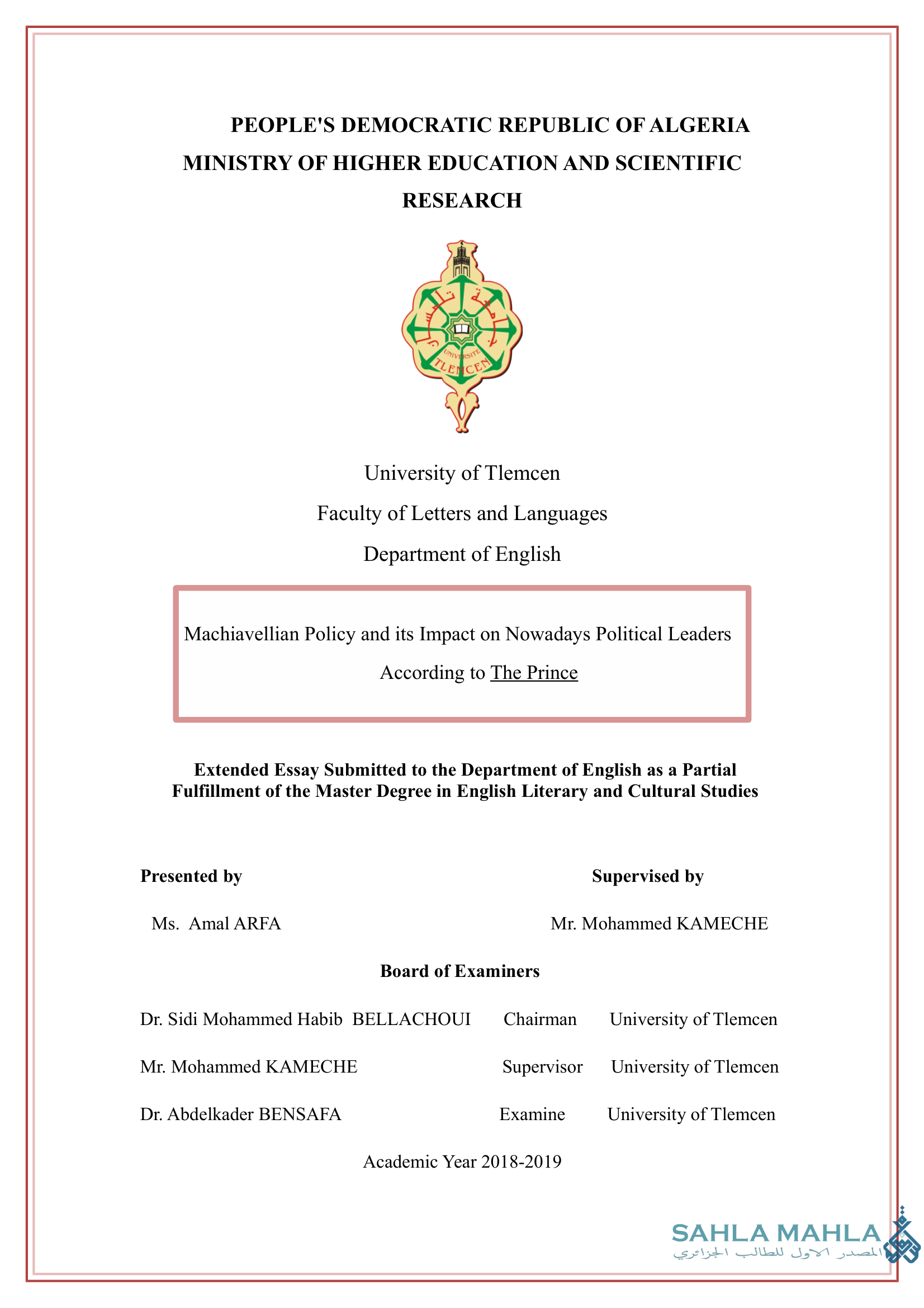
Cover Page:
Outline:
General Introduction
Chapter One: Critical Analysis of The Prince
1.1. Introduction
1.2. Nicollo Machiavelli’s Biography
1.3. The Prince’s Overview
1.4. Characterization
1.4.1. Cesare Borgia
1.4.2. Pope Alexander VI
1.4.3. Lorenzo De Medichi
1.4.4. Ferdinand De Aragon
1.5. Themes
1.5.1. Human nature
1.5.2. The Contrast Between the ideal and the real
1.5.3. Virtue
1.5.4. Fortune
1.5.5. Qualities of the Prince
1.5.6. Military forces
1.5.7. Patriotism
1.6. Analysis of the Book
1.6.1. Dedication
1.6.2. Chapters
1.6.2.1. The Variation Kinds of Principalities (chs 1-11)
1.6.2.2. The Prince and his Enemies (chs 12- 14)
1.6.2.3. The Prince and his Subjects or Friends (chs 15-23)
1.6.2.4. Prudence and Chance (chs 24-26)
1.7. Conclusion
Chapter Two: Machiavellian Policy
2.1. Introduction
2.2. The Concept of Machiavellianism
2.3. Fields of Machiavellianism
2.3.1. Political field
2.3.1.1 Machiavellianism as a political thought
2.3.1.2 Machiavellianism and realpolitik
2.3.1.3. Machiavellianism as political skills
2.3.1.4. The Impact of Machiavellianism on politics
2.3.2. Psychological field
2.3.2.1. Machiavellianism as a Personality Trait
2.3.2.2. The Dark Triad (Machiavellianism)
2.3.2.3. Machiavellian Intelligence
2.4. Characteristics of a Machiavellian Leader
2.4.1. Duplicity
2.4.2. Cunning
2.4.3. Narcissism
2.4.4. The Belief that Ends Justify Means
2.4.5. The belief of the big game Theory
2.4.6. Manipulation and Control
2.4.7 The Choice of the King Between Being Loved or Feared
2.4.8. Mystery and ambiguity
2.5. Machiavellianism in Workplace
2.6. The Point of View of Machiavellianism about Religion
2.7. Conclusion
Chapter Three: The Impact of Machiavellianism on politics and Leaders
3.1. Introduction
3.2. Machiavellianism and Society
3.3. The Relevance of Machiavellian Policy in current leaders and politics
3.4. The Impact of Machiavellianism
3.4.1. The Impact of Machiavellianism on the Arab World
3.4.1.1 Politic in the Arab World
3.4.1.2. Machiavellianism in the Arab World
3.4.1.3. Machiavellian Leaders of the Arab World
3.4.1.3.1. Abdel Fattah El-Sissi
3.4.1.3.2. Saddam Hussein
3.4.2. The Impact of Machiavellianism on the Asian Continent
3.4.2.1 Politic in the Asian Continent
3.4.2.2. Machiavellianism in the Asian Continent
3.4.2.3. Machiavellian Leaders of the Asian Continent
3.4.2.3.1. Receep Tayeb Erdogan
3.4.2.3.2. Kim Jung-Un
3.4.3. The Impact of Machiavellianism on Europe
3.4.3.1 Politics in Europe
3.4.3.2. Machiavellianism in Europe
3.4.3.3. A Machiavellian Leader in Europe
3.4.3.3.1. Adolf Hitler
3.4.4. The Impact of Machiavellianism on USA
3.4.4.1 Politics in USA
3.4.4.2. Machiavellianism in USA
3.4.4.3. A Machiavellian Leader in USA
3.4.4.3.1. Barak Obama
3.5. Conclusion
General Conclusion
Bibliography
Download The Thesis:
For more
academic sources and references,
including theses and dissertations from Algerian universities,
, visit our main website.