


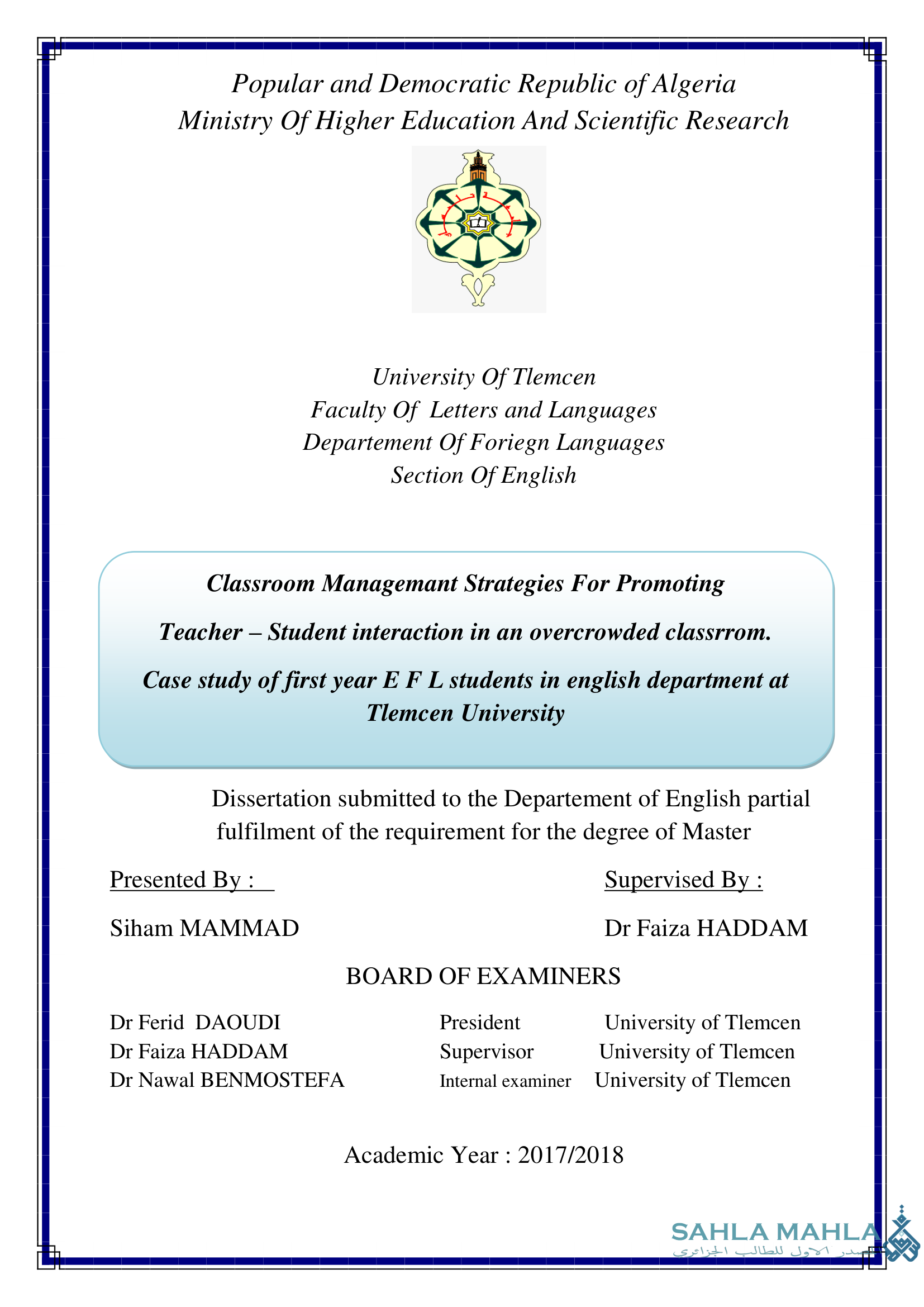
Classroom Managemant Strategies For Promoting Teacher – Student interaction in an overcrowded classrrom. Case study of first year E F L students in english department at Tlemcen University
General Information:
Master |
Level |
Classroom Managemant Strategies For Promoting Teacher – Student interaction in an overcrowded classrrom. Case study of first year E F L students in english department at Tlemcen University |
Title |
English Language Teaching |
Specialty |
Cover Page:
Outline:
General introduction
CHPTER ONE:LITERATURE REVIEW
Part one: Classroom management
1.1 Introduction
1.2 Definition of overcrowded classroom
1.3 Definition of classroom management
1.4 Classroom management goals
1.5 General problems of teaching an overcrowded class
1.5.1 Discipline the class
1.5.2 Satisfying all the students’ needs
1.5.3 Organizing efficient class activities
1.5.4 Providing equal chance for participation
1.5.5 Giving timely and effective feedback and evaluation
1.5.6 Varying the teaching methods
1.5.7 Accessing to equipment and technology
1.5.8 Motivating learners
1.6 Psychological problems
1.7 Small classes vs large classes interaction which are better
1.8 The characteristics for teaching a large class
1.9 PART TWO: Classroom interaction
1.9.1 The definition of classroom interaction
1.9.2 The importance of classroom interaction
1.9.3 The types of classroom interaction
1.9.4 The aspects of classroom interaction
1.9.4.a Negotiating of meaning
1.9.4 .b Teacher questioning
1.9.4 .c Providing feedback
1.10 The effect of motivation on classroom interaction
1.11 The effect of technology (ICT) in promoting interaction
1.12 Strategies and techniques to enhance classroom interaction
1.12.1 Discipline the class
1.12.2 Organizing the physical environment
1.12.3 Building the psycho-social environment
1.12.4 Managing collaborative or cooperative language teaching
1.12.5 Variety
1.12.6 Scaffolding
1.12.7 Providing feedback
1.12.8 Using ICT
1.13. Conclusion
Chapter two: data collection and analysis
2.1 Introduction
2.2. Teacher’s questionnaire
2.2.1 The aim of teacher’s questionnaire
2.2.2 Description of teacher’s questionnaire
2.2.3 Analysis of teacher’s questions
2.3 Student’s questionnaire
2.3.1 The aim of student’s questionnaire
2.3.2 Description of student ‘s questionnaire
2.3.3 Analysis of student ‘s questions
2.4 Summary of nthe main results
2.5 Suggestions and recommendations
2.6 Conclusion
General conclusion
Bibliography
Download The Thesis:
For more
academic sources and references,
including theses and dissertations from Algerian universities,
, visit our main website.