


Syntactic and Stylistic Analyses of automatically generation subtitles Case study English to Arabic subtitles on YouTube
General Information:
Master in Linguistics |
Level |
Syntactic and Stylistic Analyses of automatically generation subtitles Case study English to Arabic subtitles on YouTube |
Title |
Linguistics |
Specialty |
Cover Page:
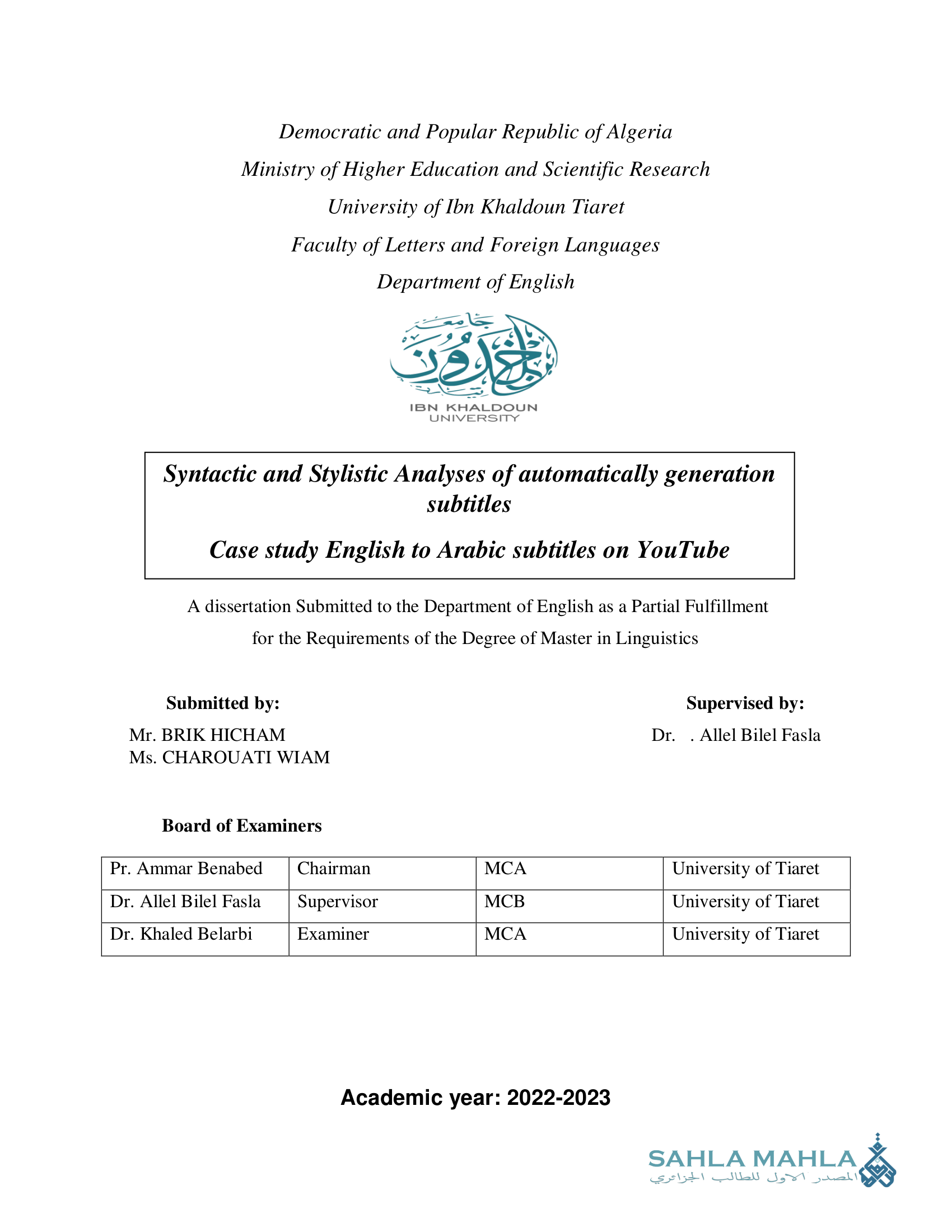
Outline:
GENERAL INTRODUCTION CHAPTER I: STYLISTICS AND SYNTACTICS ANALYSIS 1.1 INTRODUCTION: 1.2 STYLISTIC ANALYSES. 1.2.1 Definition of Syntactic Analysis. 1.2.2 Importance of syntactic analysis. 1.2.3 Relation between Syntactic Analysis and Language Understanding. 1.2.4 Syntactic Structure and Grammatical Rules. 1.2.4.1 Syntactic structure. 1.2.4.2 Grammatical rules 1.2.5 Sentence structure and syntactic rules. 1.2.5.1 Sentence structure. a. Subject b. Object c. Adjectives d. Adverbs e. Prepositions f. Conjunctions g. Sentence types h. Sentence clauses i. Sentence punctuation. 1.2.5.2 Syntactic units. a. Words. b. Phrases c. Clauses. d. Sentences 1.2.6 Part of speech and word categories. 1.2.7 Phrase structure rules. 1.2.8 Syntactic Dependency and Relation 1.2.9 Syntactic Parsing technique. 1.2.10 Rule based parsing. 1.3 CONTEXT-FREE GRAMMAR AND PARSING ALGORITHMS: 1.3.1 Context-free grammar. a. Terminals b. Non-terminals c. Production Rule. d. Start Symbol. 1.3.2 Parsing algorithms 1.3.2.1 Top-Down Parsing 1.3.2.2 Bottom-up parsing. 1.3.2.3 Dependency parsing and dependency grammar a- Dependency parsing. b- Dependency grammar. c- Differences between Dependency parsing and dependency grammar. 1. Dependency Parsing. 2. Dependency Grammar – Transition-based dependency parsing – Transition-based dependency parsing uses a transition system. – The transition actions. 1.3.2.4 Graph-based dependency parsing and Constituency parsing. a- Graph-based dependency parsing. 1. Input Representation: 2. Scoring Model. 3. Dependency Graph Construction. 4. Decoding. 5. Training. b- Constituency parsing. 1. Tokenization 2. Part-of-Speech (POS) Tagging. 3. Grammar Rules 4. Parsing Algorithm. 5. Constituent Construction 6. Parse Tree Representation. 1.4 TREEBANK AND CONSTITUENT PARSING ALGORITHMS. 1.4.1 Treebank: a. Annotation. b. Syntactic Frameworks c. Structure Representation. d. Linguistic Coverage e. Uses and Applications. 1.4.2 Constituent Parsing Algorithms a. Top-Down Recursive Descent. b. Bottom-Up Shift-Reduce 1. Top-Down Recursive Descent 2. Bottom-Up Shift-Reduce. 1.4.3 Chart Parsing: a. Chart Initialization. b. Lexical Insertion. c. Chart Expansion. d. Predictions. e. Scanning. f. Completions. g. Back pointers. h. Parsing Completion. 2.1 STYLISTIC ANALYSIS 2.1.1 Definition of Stylistic Analysis. 2.1.2 Importance of Stylistic Analysis. a. Text Classification: b. Authorship Attribution: c. Sentiment Analysis. d. Plagiarism Detection. 2.2.1 Stylistic Analysis Features. 2.2.2 Lexical Stylistic Feature 2.2.3 Syntactic Stylistic Feature a. Sentence length b. Part-of-speech (POS) tagging. c. Syntactic parsing 2.3 STYLISTIC TECHNIQUES. 2.3.1 Corpus-based Analysis: a. Corpus Collection b. Representative Data c. Quantitative Approach. d. Corpus Annotation. e. Research Questions: f. Corpus Tools and Software g. Application Areas. 2.3.2 Machine learning Approaches. 2.3.3 Deep Learning Approaches. 4.1 RELATIONSHIP BETWEEN SYNTACTIC AND STYLISTIC ANALYSIS a. Programming Languages. b. Natural Language Processing (NLP). c. Computational Linguistics: d. Text-to-Code Generation 4.2 INFLUENCE OF STYLE AND SYNTAX ON EACH OTHER. 4.2.1 Influence of syntax on style. 4.2.2 Influence of style on syntax. 4.2.3 Importance of Combined Analysis. 5.1 CONCLUSION. CHAPTER II: SUBTITLES AND AUTOMATIC GENERATIONS (STYLE AND SYNTAX) 2.1.1 Introduction. 2.1.2 Definition of subtitles. 2.1.3 Types of Subtitles. a. Closed Subtitles b. Open Subtitles: c. Forced Subtitles. d. SDH (Subtitles for the Deaf and Hard of Hearing): e. Machine-Generated Subtitles f. Verbatim Subtitles: g. Audio Description Subtitles. 2.1.4 Importance of Subtitles. A. Enhancing accessibility for individuals with hearing impairments B. Facilitating understanding of content in different languages. C. Improving comprehension for viewers with language barriers. D. Supporting learning and education. E. Enabling enjoyment of media in noisy or quiet environments. 2.1.5 Subtitle Creation Process. a. Transcription and time-coding. b. Translation and localization c. Editing and proofreading. d. Formatting and synchronization e. Quality assurance and review Quality assurance. 2.2 THE AUTOMATICALLY GENERATING OF SUBTITLES (STYLE AND SYNTACX). 2.2.1 Introduction. 2.2.2 Understanding Artificial Intelligence and Subtitle Generation. 2.2.2.1 Definition of Artificial Intelligence. 2.2.2.2 Aspects of AI’s involvement in subtitle generation a. Automatic Speech Recognition (ASR): b. Natural Language Processing (NLP) c. Timing and Synchronization d. Machine Translation e. Quality Assurance. f. Named Entity Recognition (NER): 1. Hidden Markov Models (HMMs): 2. Recurrent Neural Networks (RNNs): 2.2.3 Style and syntax of Automatically Generated Subtitles 2.2.3.1 Style of Automatically Generated Subtitles a. Natural language processing techniques: b- Tone and emotion recognition: c- Contextual understanding and adaptation: d. Multilingual support: e- Formatting and visual presentation: 2.2.3.2 Syntax of Automatically Generated Subtitles 2.3 MACHINE LEARNING, TECHNIQUES AND ALGORITHMS FOR STYLE AND CONTEXT ANALYSIS. 2.3.1 Overview of Machine Learning: 2.3.2 Natural Language Processing (NLP) for style recognition and analysis 1. Feature Engineering: 2. Naive Bayes Classifier: 3. Support Vector Machines (SVM): 4. Decision Trees: 5. Random Forests: 6. Recurrent Neural Networks (RNN): 7. Convolutional Neural Networks (CNN): 8. Transformer Models: 9. Feature-based methods: 10. Text classification algorithms: 11. Authorship attribution: 12. Sentiment analysis: 13. Deep learning techniques: 2.3.3 Contextual understanding using machine learning models. 1. Contextual Word Embeddings: 2. Pre-trained Language Models: 3. Attention Mechanisms: 4. Handling Ambiguity: 5. Contextual Adaptation: 2.3.4 Integration of contextual data from audio, video, or metadata sources 1. Data Collection and Preprocessing: 2. Multimodal Fusion: 3. Feature Extraction: 4. Metadata Utilization: 5. Machine Learning and AI Models: 6. Semantic Understanding: 7. Real-Time Processing: 8. Application Areas: 2.3.5 Recap of the importance of style and context in automatic subtitle generation. 1. Accuracy and Clarity: 2. Language Adaptation: 3. Idiomatic Expressions and Slang: 4. Speaker Identification: 5. Handling Ambiguity: 6. Consistency: 7. Multimodal Fusion: 8. Subtitle Presentation: 9. Accessibility and Inclusivity: 10. Language and Cultural Sensitivity: 2.4 CONCLUSION. CHAPTER III: EVALUATION OF AUTOMATICALLY GENERATED SUBTITLES ON TWO TYPES OF VIDEOS FROM ENGLISH TO ARABIC. 3.1INTRODUCTION. 3.2 YOUTUBE OVERVIEW: 3.3 ANALYSIS STUDIES ON STYLISTIC AND SYNTACTIC SUBTITLING OF YOUTUBE VIDEOS. 3.3.1Discussions: 1. Study Stylistic Aspects: 2. Analyze Syntactic Aspects: 3.4 EXAMPLES OF EFFECTIVE STYLISTIC AND SYNTACTIC SUBTITLES ON YOUTUBE. GENERAL CONCLUSION.
Download The Thesis:
For more academic sources and references, including theses and dissertations from Algerian universities, , visit our main website.