


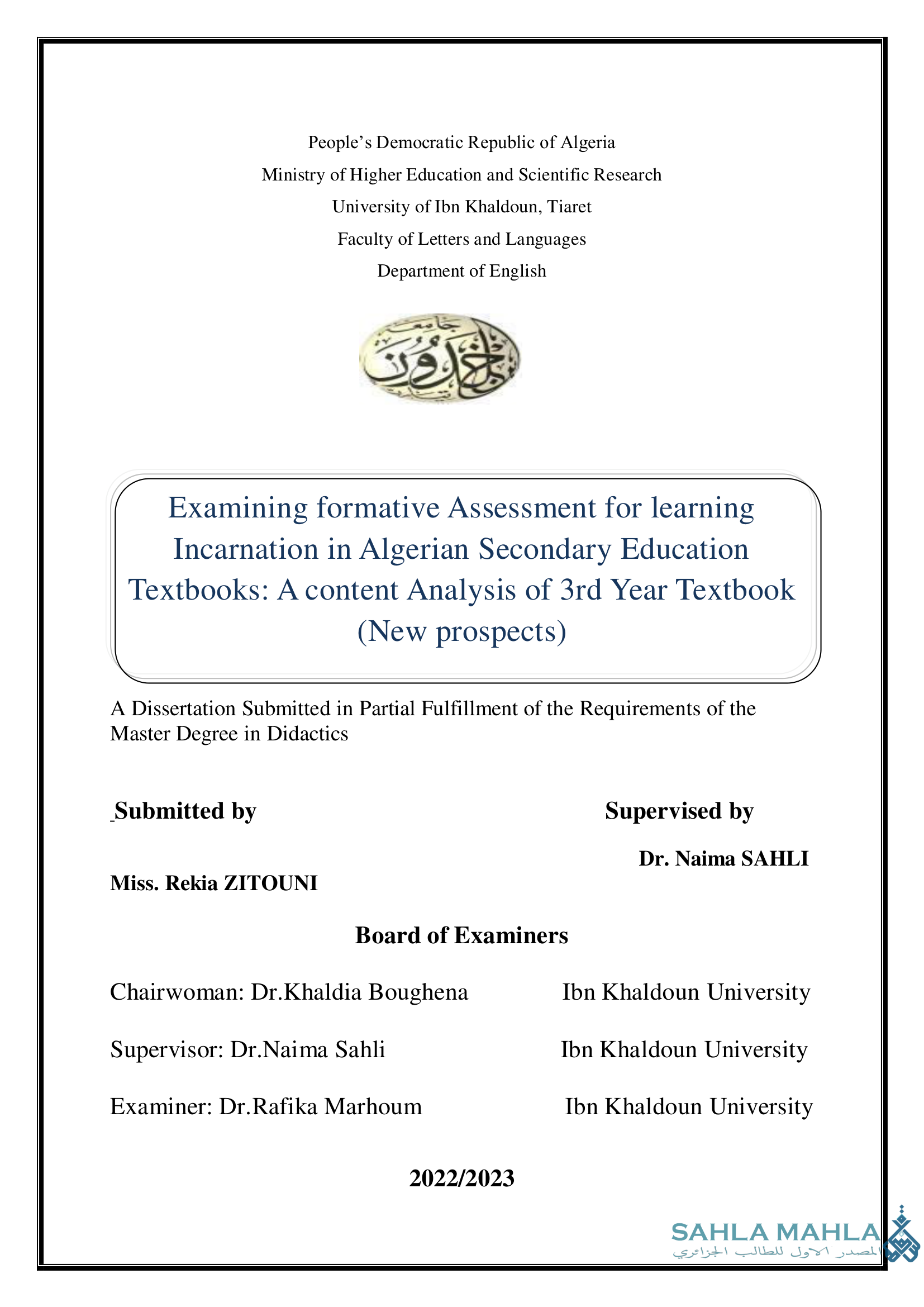
Examining formative Assessment for learning Incarnation in Algerian Secondary Education Textbooks: A content Analysis of 3rd Year Textbook (New prospects)
General Information:
Master Degree in Didactics |
Level |
Examining formative Assessment for learning Incarnation in Algerian Secondary Education Textbooks: A content Analysis of 3rd Year Textbook (New prospects) |
Title |
Didactics |
Specialty |
Cover Page:
Outline:
General Introduction Statement of the Problem Research Question Hypotheses Aims of the study Means of study Structure of the study CHAPTER ONE: The role of formative assessment and textbook in English language learning Introduction 1.1. Part one: formative assessment 1.2. Definition of formative assessment 1.3. The importance of formative assessment 1.4. Tools of formative assessment 2.3.1.1. Questioning 2.3.1.2. Closed/open questions 2.3.1.3. High-order/ low order question 2.3.1.4. Initiation-Response-Evaluation (I-R-E) 2.3.1.5. Deciding wether to move on 2.3.2. Feedback 2.3.2.1. Variations of feedback strategies 2.3.2.2. Variations of feedback content 2.3.3. Rubrics 2.3.3.1. Purpose of rubrics 2.3.3.2. Types of rubrics 2.3.4. Checklist 3. Part two: textbook 3.1. Definitions of Textbook 3.2. Advantages and Disadvantages of Textbook 3.3. EFL Textbook in Algeria 3.3.1. New Prospects: literature of Review 3.3.2. Syllabus of English for third year classes in secondary schools 4. Conclusion CHAPTER TWO: field work Introduction 2. Analysis of content of the “New prospects” textbook 2.1. Definition of content analysis 2.2. General introduction about the “New Prospects” Textbook 2.2.1. Presentation of “New prospects textbook” 2.3. Formative assessment in the New Prospects textbook 2.3.1. Analysis the activities of the Units in the Textbook 2.4. Finding of Analysis 3. Teacher’s questionnaire 3.1. Definition of questionnaire 3.2. Administration of questionnaire 3.3. Description of the questionnaire 3.4. Data Analysis 4. Conclusion CHAPTER THREE: discussion and recommendations 1. Introduction 2. Discussion of the Results 3. Suggestions and Recommendations 4. Conclusion General Conclusion References
Download The Thesis:
For more academic sources and references, including theses and dissertations from Algerian universities, , visit our main website.