


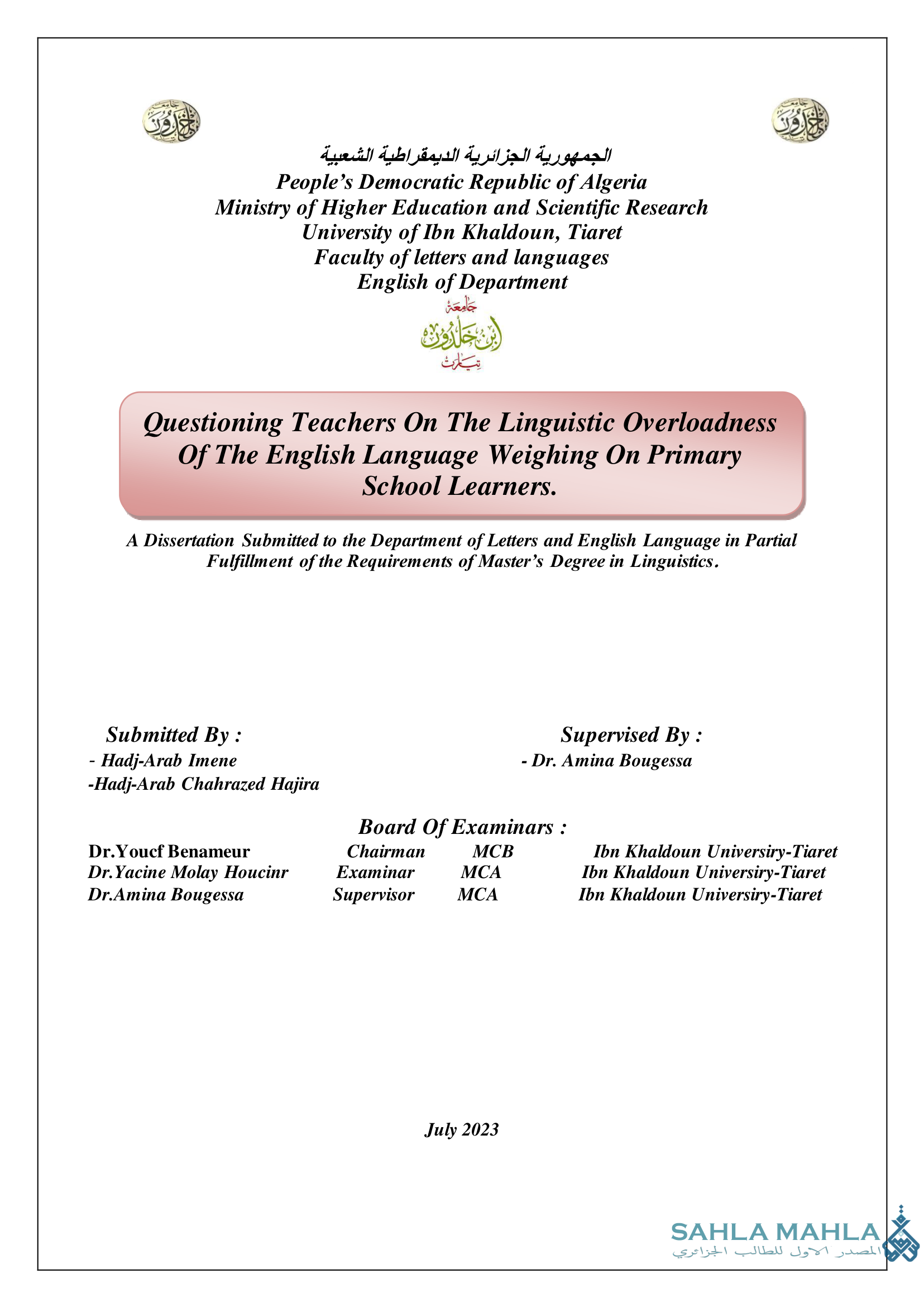
Questioning Teachers On The Linguistic Overloadness Of The English Language Weighing On Primary School Learners.
General Information:
Master’s Degree |
Level |
Questioning Teachers On The Linguistic Overloadness Of The English Language Weighing On Primary School Learners. |
Title |
Linguistics |
Specialty |
Cover Page:
Outline:
General Introduction Chapter One: The Introduction Of the English Language In Algeria Introduction 1.1.The English Language I.1.1.The Importance of the English Language. I.1.2.Motivation to Learn English in Algeria. I.2.What is learning? 1.2.1. The Stages of Learning. 1.2.2. The Five-step Cycle to Improve Learning. 1.3. What is Teaching? 1.3.1 Techniques of Teaching. 1.3.2. The Three Basic Steps of Teaching. 1.3.2.1. Preparation:. 1.3.2.2-. Delivery: 1.3.2.3. Evaluation:… 1.3.3. Phases of Teaching 1.3.1. Pre-active Stage. 1.3.2. Interactive Stage. 1.3.3. Post-Active Stage. I.4. What is ESP and EGP?.. 1.4.1. ESP Meaning and EGP Meaning. 1.4.1.1Esp Meaning 1.4.1.2.EGP Meaning… 1.4.2. Similarities and Differences of ESP and EGP.. I.4.3. Comparative roles of an ESP and EGP teacher… 1.5.Implementing The English Language in Primary Schools. 1.5.1. Algerian Educational Reform… 1.5.2. Arabization in Algeria 1.5.2.1. Implementation of Arabization Policy 1.6. Benefits and Challenges of Teaching English in Primary Schools. 1.6.1. Benefits of Teaching English in Primary Schools 1.6.2. Challenges in Teaching English in Primary Schools… Conclusion Chapter Two: The Educational System in Algeria Vs In Tunisia Introduction II.1.The Sociolinguistic Profile of Tunisia II.1.1.Historical Perspective. II.1.2. Political perspectives. II.1.3.Educational perspectives II.2.Languages in the Educational System of Tunisia II.2.1. The different Languages Used in education.. II.2.2. TEFL in Tunisian Education. II.3.The Sociolinguistic Profile of Algeria II.3.1.A Brief History of Languages in Algeria. II.3.2.The Policy of Teaching English in Algeria. II.3.2.1. The lack of audiovisual materials, books, journals, and magazines II.3.2.2. The aim of teaching English in Algeria II.4.The Status of English in Algeria II.4.1. English as a Global Language. II.4.2. Educational System. II.4.3 Social Life. 11.4.4. Political Prescpective.. II.5.Teaching English at primary schools II.6.The Difference between The Algerian and The Tunisian Educational System. II.6.1.Comparison Between the Curriculum in Algeria and Tunisia. II.6.1.1. Learning Different Laaguages.. II.6.1.2. Recent Reforms of the Program. II.6.1. Objectives of Teaching and Learning English in primary school. II.6.1. Integration of Language Skills II.6.1.2. Incorporation of Cultural Components Conclusion Chapter Three: Research Methodology and Data Analysis Introduction Section One: Methodology III.1.Research Method: III.2.The Participants: III.3.Data Instruments:. III.3.1. Teachers Questionnaire:. III.3.1.1 Description of the Questionnaire: III.3.2. Parents Quastionnaire: III.3.2.1. Description of the Questionnaire. III.4.The interview: III.4.1.Description of the interview:.. III.5.Reliability and Validity:.. III.6.Limitations of the Study:. Section Two: Data Analysis and Results.. III.1. The Data Analysis of the Teachers Questionnaire:. III.1.1 Teachers Part:. III.1.2.Pupils competence: III.2.3.Discussion of The Results:. III.3. The Data Analysis of the Parent’s Questionnaire. III.3.1. Discussion of the Results. III.4. Analysis of the interview III.4.1 Discussion of the Results:… III.5. Recommendations…… III.5.1.Teacher Training and Support: III.5.2.Potential Solutions: Conclusion General conclusion
Download The Thesis:
For more academic sources and references, including theses and dissertations from Algerian universities, , visit our main website.